Guide
What is lettering in comics?

Comic lettering is all the text a reader reads on a comic page: the dialogue, the balloons that hold it, the captions, the sound effects and the titles. The letterer picks the fonts, sizes and balloon shapes and sets the reading order. In translated manga and webtoons, the same work splits into cleaning, typesetting and sound effect redraws.
Table of contents
- What is lettering in comics?
- What are the parts of comic lettering?
- What does a letterer decide on each page?
- What is manga lettering, and what is typesetting?
- What is cleaning, and what is a redraw?
- What is SFX in manga?
- How do lettering, typesetting and cleaning fit together?
- What software do letterers use?
- What does lettering cost?
Lettering is the craft that makes the words on a comic page readable and leads the eye through each panel. In translated manga, manhwa and webtoons, the same work is split into three jobs: cleaning (removing the source text), typesetting (placing the new text) and sound effect work (subtitling or redrawing the drawn sounds). This page defines each term and shows how they fit together.
What is lettering in comics?
Wikipedia's article on letterers describes a letterer as the member of a comic team responsible for drawing the comic's text: display lettering for titles and credits, the text in word balloons, and sound effects. Many letterers also design logos for a publisher's titles.
From the 1930s through the 1990s, with few exceptions, letterers worked by hand, in pen and ink on the original art page. Around 1990 the first commercial comic book fonts appeared, and in the early 1990s letterer Richard Starkings and his partner John Roshell began making digital comic fonts and started Comicraft. Fonts made to look like hand lettering are now the usual tool.
What are the parts of comic lettering?
| Part | What it is |
|---|---|
| Balloon | The shape that holds spoken words, with a tail to the speaker |
| Caption | A box for narration, inner thoughts, time or place |
| Sound effect | A word drawn into the art for a sound, motion or mood |
| Keyline | An outline around letters or a balloon that keeps it readable over art |
| Display lettering | Titles, chapter names, credits and logos |
Balloon shapes carry meaning. Blambot's guide to comic book grammar lists the conventions. A whisper gets a dashed outline. A thought gets a cloud with a tail of small circles. A shout gets a burst. Bold italic marks a stressed word, and plain bold is rare in dialogue.
What does a letterer decide on each page?
- Reading order. The balloons lead the eye through the panel in the right sequence.
- Font and size. One main dialogue font for the series, with variations for shouts, whispers, thoughts and narration.
- Balloon shape and tail. The shape tells the reader how the line sounds. The tail tells the reader who speaks.
- What stays clear. Faces, hands and key action stay free of text.
- Sound effects. Size, angle, colour and outline, matched to the action.
What is manga lettering, and what is typesetting?
In Japan, manga lettering is split in two. The dialogue in the balloons is set in type, not drawn by the artist. The sound effects are drawn by the artist as part of the art. So when a manga is translated, the new dialogue goes into balloons that already exist, and the sound effects need a separate decision. That job has its own name.
Typesetting puts translated text into the balloons of a page that already exists. Wikipedia's scanlation article gives the same definition. The typesetter fits the text into the dialogue boxes of the cleaned page and chooses fonts for effects such as emphasis.
The word comes from print, where typesetting means setting text in type. Shueisha's Manga-Art project explains that manga text was first set in movable metal type, which phototypesetting later replaced: the text was printed on photographic paper and pasted onto the page by hand. Fan translation groups took the word from there. Western creators say lettering for the same craft. Korean uses 식자 (sikja) and Japanese uses 写植 (shashoku).
Our guide on how to typeset manga covers fonts, sizes, line breaks and the common mistakes.
What is cleaning, and what is a redraw?
Cleaning removes the source language text from the page so the new text can go in. Text in a plain bubble needs a flat fill. When you erase text on the art, it leaves a hole. That hole needs a redraw: the lines and screentone that the letters covered are rebuilt so the reader cannot see the patch.
Good cleaning is invisible. Bad cleaning is obvious. Read how to clean manga for the methods.
What is SFX in manga?
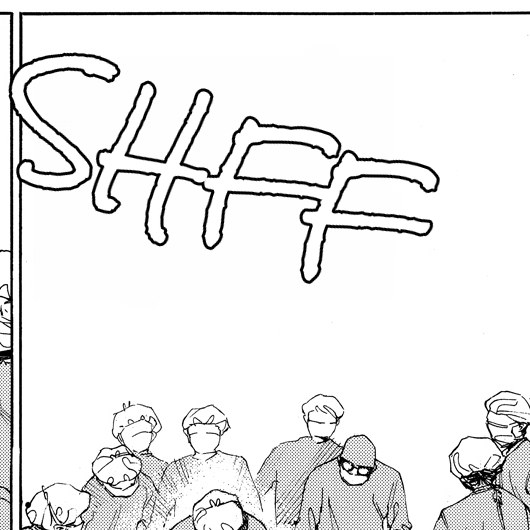
SFX in manga means sound effects: words drawn into the art for a sound, a motion or a feeling. Japanese has a large set of sound symbolic words. Linguists split them into groups. Giongo copy the sounds of objects, such as rain falling (zā-zā). Giseigo copy the sounds of living things, such as a dog barking (wan-wan). Gitaigo show states and manners, such as damp or stealthily. A fourth group, gijōgo, shows feelings. Many manga sound effects show something with no sound at all, like silence or a glare. The general term is onomatopoeia.
The manga artist usually draws the sound effects as part of the art. Nobody sets them in type. That is why they are hard to translate. A translated release has three choices:
| Choice | What happens | Work needed |
|---|---|---|
| Subtitle | The original stays, a small translation sits next to it | Typesetting only |
| Replace | Erase the original and draw a new sound effect in the target language | Cleaning, redraw and new lettering |
| Leave | The original stays, untranslated | None |
Browse the meanings in our Japanese sound effect dictionary.
How do lettering, typesetting and cleaning fit together?
| Term | Who says it | What it covers |
|---|---|---|
| Lettering | Western creators and publishers | All text on an original page, including balloon placement |
| Typesetting | Scanlation groups and manga translators | Text placed into existing balloons on a translated page |
| Cleaning | Translation teams | Removing the source text |
| Redraw | Translation teams | Rebuilding art under removed text and sound effects |
| Localization | Publishers | The whole process: translation, cleaning, lettering, sound effects and checks |
On a translated chapter the order is: translation, proofreading, cleaning and redraw, typesetting, then a quality check. On small teams one person does several steps.
What software do letterers use?
Most lettering today happens in design and image software, with fonts that copy hand lettering. The tools depend on who pays:
| Who | Usual tools | Source |
|---|---|---|
| Manga publisher letterers | InDesign, Photoshop and Illustrator. Yen Press asks letterers to be comfortable in all three, and does not ask them to read Japanese or Korean | Yen Press FAQ |
| Scanlation typesetters | Photoshop at 72 DPI, with a text stroke that the tutorial says is usually 3 px | Nekyou typesetting tutorial |
The fonts matter as much as the software. Comicraft and Blambot are two of the best-known makers of lettering fonts, and Blambot gives its indie fonts free to independent comics. Our guide to free lettering fonts lists the options and their licences. A letterer who wants a translated comic to look native also needs the sound effect skills of a cleaner and a redrawer, which is why these jobs overlap so often on small teams.
What does lettering cost?
There is no single published rate. Yen Press lists a starting rate of $800 per lettering project, which is one volume. Comicraft's Balloon Tales site gave $20 to $50 a page at Marvel and Image in 2004, and $10 or $15 at smaller companies. Publishers Weekly reported manga lettering offers as low as $1 to $1.15 a page in 2023. Our guide on manga translator pay lists every rate we could check.
Bublate does the first pass of all three jobs from $3 a webtoon chapter, up to $0.60 a manga page (up to 20 segments). New accounts get 30 free credits, enough for 3 webtoon chapters or 15 manga pages. It cleans the page and typesets every bubble in a fitted lettering font. It also redraws the sound effects in the target language. A letterer or translator then checks each page in the editor and makes the final call.
Frequently asked questions
What is lettering in comics?
Lettering is all the text on a comic page: dialogue, balloons, captions, sound effects and titles. The letterer chooses the fonts, the sizes and the balloon shapes, and sets the reading order so the words lead the eye through each panel.
What is SFX in manga?
SFX means sound effects: words drawn into the art for a sound, a motion or a feeling. In Japanese they include giongo, giseigo and gitaigo, and many show things that make no sound, such as shīnto (silently). The artist draws them as part of the art.
What is typesetting?
In comics, typesetting puts translated text into the balloons of an existing page, with the right font, size and line breaks. Scanlation groups and manga translators use the word. Western creators and publishers call the same craft lettering.
Is lettering the same as typesetting?
The craft rules are the same: font, size, line shape and comic grammar. Lettering is the wider job and includes drawing balloons and display lettering on an original comic. Typesetting usually works inside balloons that already exist on a translated page.
Who letters manga in Japan?
Japanese manga dialogue is set in type, first in metal type and later by phototypesetting, so the artist does not letter the balloons by hand. The artist usually draws the sound effects as part of the art, which is why they are hard to translate.
Sources
- Wikipedia, Letterer · checked
- Wikipedia, Scanlation · checked
- Wikipedia, Japanese sound symbolism · checked
- Blambot, Comic Book Grammar and Tradition · checked
- Shueisha Manga-Art, Discussing the Letterpress Vol. 3 · checked
- Nekyou Scanlation, Typesetting Tutorial (2020) · checked
- Yen Press, FAQ (freelance starting rates) · checked
- Balloon Tales (Comicraft), The Business of Comics (2004) · checked
- Publishers Weekly, Deb Aoki, Manga freelancers say: show me the money (26 Apr 2023) · checked