Guide
What is the difference between translation and localization in manga and webtoons?
Translation moves the words of a comic into another language. Localization adapts the whole comic for readers in one market: the words, but also honorifics, jokes, food, units, names, sound effects, lettering and format. Transcreation goes one step further and rewrites a line so it has the same effect, even when the words change. Most official releases mix all three.
Table of contents
- What is the difference between translation and localization?
- What does localization change in a manga or webtoon?
- What is transcreation?
- Translation vs localization: examples from comics
- How do you decide how much to localize?
- Is localization the same as internationalization?
- How does Bublate handle localization?
Publishers say "localization" and fans say "translation", and they often mean the same release. The two words are not the same, though, and the difference decides what a team does to each page. This page defines both and adds transcreation. It shows what each one changes in a manga or webtoon, and how to write the choice down so it stays the same in every chapter.
What is the difference between translation and localization?
Translation changes the language of the text. Localization changes the product for a market. The W3C, which writes the standards of the web, defines localization as "the adaptation of a product, application or document content to meet the language, cultural and other requirements of a specific target market (a locale)". It adds that localization is "often thought of only as a synonym for translation", but "is often a substantially more complex issue".
The W3C list of what localization can change includes number, date and time formats, currency, symbols and colors, name ordering, and "text and graphics containing references to objects, actions or ideas which, in a given culture, may be subject to misinterpretation". Every one of those items appears on comic pages.
| Translation | Localization | Transcreation | |
|---|---|---|---|
| What changes | The words | The words and what they refer to, plus the page | The message, rewritten for the same effect |
| Goal | The same meaning | A comic that reads as if made for this market | The same reaction from the reader |
| Freedom | Low | Medium, set by house rules | High |
| Comic example | 先輩、待って! becomes "Senpai, wait!" | "Wait up!" or the senior's name, by the series rule on honorifics, lettered to fit the bubble | A pun on a Japanese word becomes a new pun in English |
What does localization change in a manga or webtoon?
- Honorifics and forms of address. Keep -san and oppa, translate them, or drop them. See Japanese honorifics and Korean honorifics.
- Names and name order. Family name first or last, and one spelling per name. See why character names change between chapters.
- Food, school and daily customs. Keep "bento" or write "packed lunch". Both are correct, so the series needs a rule.
- Jokes, puns and wordplay. A literal translation of a pun is rarely funny. This is where localization turns into transcreation.
- Units, money and dates. Yen or dollars, metres or feet, and the date order of the market.
- Sound effects. Redraw them, keep the original with a small caption, or leave them. See how to translate Korean sound effects.
- Lettering. Fonts, bubble fit and styles for shouts and whispers in the target language. See the manga lettering guide.
- Format. Reading direction, page or strip size, and the rules of the platform. See how to read manga and webtoon export sizes.
What is transcreation?
Transcreation joins "translation" and "creation". The Wikipedia article describes it as "adapting a message from one language to another, while maintaining its intent, style, tone, and context", and says it "is related to the concept of localization". In a comic, transcreation is the right tool for a small part of the text: puns, song lyrics, a catchphrase, a chapter title, a sign gag in the art. The rest of the page needs a faithful translation, or readers lose the story the artist drew.
Translation vs localization: examples from comics
| Source | Close translation | Localized |
|---|---|---|
| お弁当 (obentō) in a school scene | bento | packed lunch |
| 선배 (seonbae), said to an older student | sunbae | the senior's name, or no address |
| 身長180センチ (180 cm tall) | 180 cm tall | almost six feet tall |
| A pun on two Japanese words that sound alike | The literal words, with a TL note | A new pun in the target language |
| ゴゴゴ (gogogo) drawn in the art | The original, with a caption: RUMBLE | Redrawn as RUMBLE in the art |
None of the columns is the correct one. Many manga readers prefer the close version and expect honorifics. A general audience on a webtoon platform may prefer the localized one. The glossary entry on localization has a short table of light, medium and heavy approaches. The rule that matters is the same in every chapter: pick one approach per series and per language, and write it down.
How do you decide how much to localize?
- Ask who the reader is. Fans of the original, or new readers who have never read a manga.
- Read the platform and the contract. A licensor or a platform can set rules for honorifics, names and sound effects.
- Decide per category, not per line. Honorifics, names, food, units, sound effects and jokes each get one rule.
- Write the rules down before chapter 1. Use the style rules section of a series bible template and a translation glossary.
- Check the rules in every chapter. A new translator or a new chapter is where a rule breaks first.
Is localization the same as internationalization?
No. The W3C defines internationalization as "the design and development of a product, application or document content that enables easy localization". For a comic, that is the work before any translation: text on its own layer, clean art under the bubbles, and sound effects that a letterer can lift off the art. A creator who letters on separate layers makes every later localization cheaper.
How does Bublate handle localization?
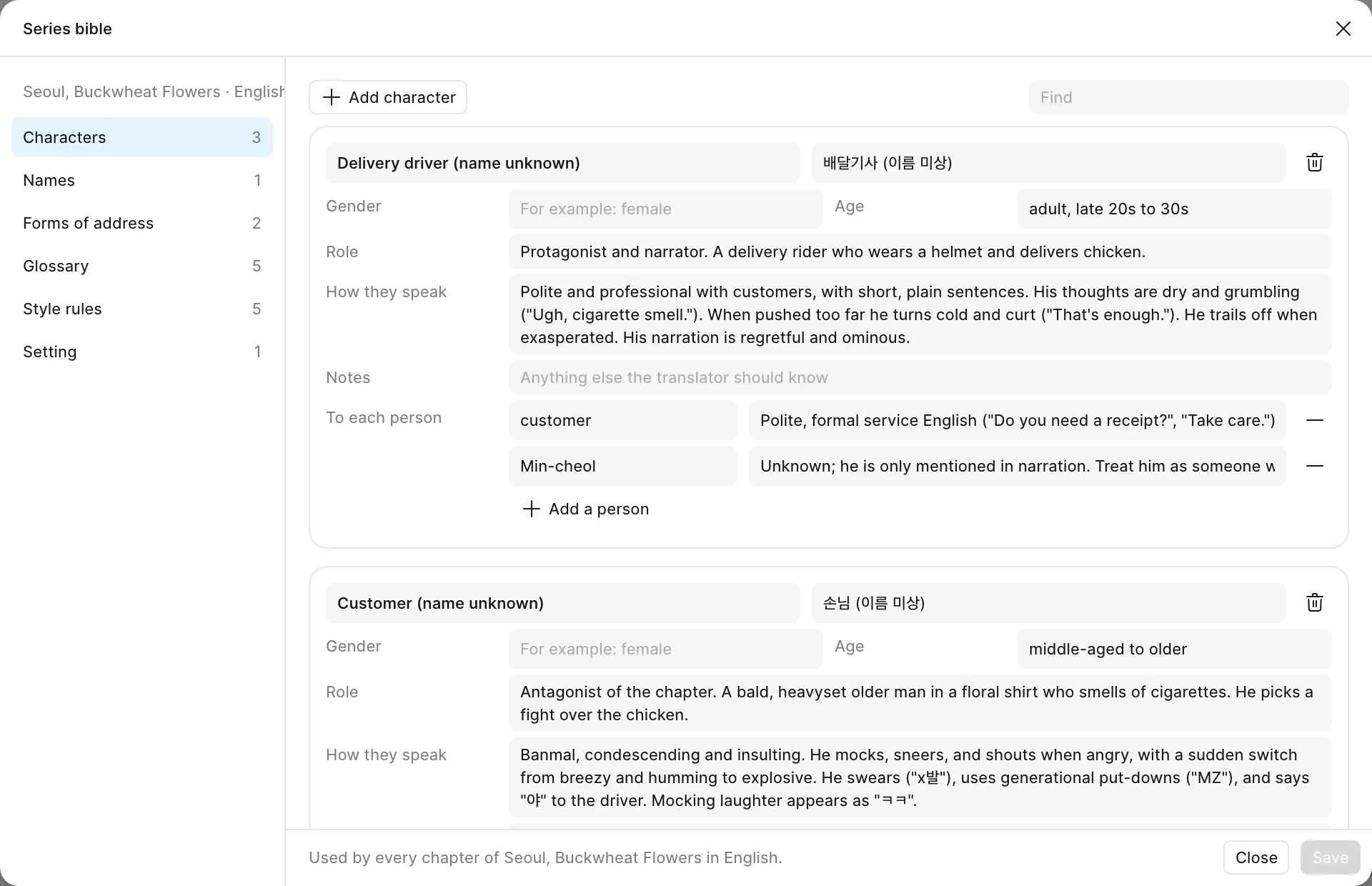
Bublate translates, cleans, letters and handles sound effects in one pass, and then you edit the result. The localization rules live in the series bible, one per series and target language. It holds the characters, names, forms of address, a glossary with the rule "always" or "prefer" for each term, and style rules such as the honorific policy, swearing level, units and name order. Every new chapter starts from the same bible.
- A chapter note of up to 1,000 characters goes to the translate, polish and review steps, for a choice that applies to one chapter.
- Translate again with a note on one block, such as "shorter", "more formal" or "he is joking", when a line needs a different approach.
- Sound effects: Bublate translates and redraws them, keeps them as drawn, or keeps them with a small caption next to the art. You pick per sound effect.
- Export presets follow the size limits of WEBTOON CANVAS, Naver, Tapas, LINE Manga Indies and Jump Rookie.
A webtoon chapter costs $3 and a manga page costs up to $0.60, and a new account gets 30 free credits. Publishers with a catalogue can read Bublate for publishers.
Frequently asked questions
What is the difference between translation and localization?
Translation changes the words into another language. Localization adapts the whole product for one market: the words, and also customs, names, units, images and format. In a comic, localization also covers honorifics, sound effects and lettering, so it is the larger job and translation is one part of it.
What is manga localization?
Manga localization is the full work of making a manga for readers in another market: translation, an honorific and name policy, adapted jokes, sound effects, lettering in the target language and the platform format. Publishers use the word for the whole job, from the script to the finished pages.
Is localization better than translation?
Neither is better. A close translation suits readers who want the original culture on the page, with honorifics and Japanese or Korean terms kept. A heavier localization suits a general audience. The mistake is to mix both in one series, so pick one approach and keep it in every chapter.
Is transcreation the same as localization?
No. Transcreation rewrites a message so it has the same effect, even when the words change. Localization is the wider work of adapting a product for a market. In a comic, transcreation fits a small part of the text, such as puns, songs and titles, inside a localized release.
Does localization change honorifics?
It can. A release can keep honorifics such as -san or oppa, translate them into titles, or drop them. Each choice is valid. What matters is one written rule per series and per language, so the same character is not "Tanaka-san" in one chapter and "Mr. Tanaka" in the next.
Does Bublate localize or only translate?
Bublate translates, cleans, letters and handles sound effects in one pass, and it follows the localization rules in the series bible: names, forms of address, glossary terms and style rules such as the honorific policy. It does not choose those rules for you, and a person who knows the market should check the result.
Sources
- W3C Internationalization, Localization vs. Internationalization · checked
- Wikipedia, Transcreation · checked
- Wikipedia, Language localisation · checked