Guide
Readers say the names change between chapters. Why, and how do I fix it?
Names drift when chapters are translated without one shared name list: a new translator, a machine translation run chapter by chapter, or two romanization systems for the same language. Fix it by picking one spelling per name, writing it in a glossary that every chapter must follow, and correcting released chapters starting with the first ones readers open.
Table of contents
Readers forgive a lot, but they notice a changed name at once. A lead who is Min-jun in chapter 12 and Minjun in chapter 13 looks like a mistake, and a lead who becomes Minjoon looks like a different person. This page explains where the drift comes from, shows the same names in the systems that cause it, and gives a fix for chapters that are already out.
Why do character names change between chapters?
- A new translator. Each person makes their own choices unless the old ones are written down. See my translator quit mid-series.
- Machine translation, one chapter at a time. A tool that sees one chapter does not know how the last chapter spelled a name. Without a glossary, it decides again every time.
- Two romanization systems. Korean, Japanese and Chinese each have more than one official way to write names in Latin letters. Two translators who each follow a correct system can still disagree.
- An official spelling arrives late. The creator or the licensor confirms a spelling after chapters are out. VIZ editor Holly Fisher told SKTCHD in 2025 that VIZ asks the Japanese publisher "when we have a name of a character that could be spelled multiple different ways".
- Name order flips. Family name first in one chapter, last in the next.
- Honorifics come and go. Ji-ho, Ji-ho-ssi and Ms. Ji-ho read as three policies. See Korean honorifics and Japanese honorifics.
How can one name have several correct spellings?
Because the official systems differ. The examples below come from the official tables, not from any one series.
Korean: Revised Romanization and McCune-Reischauer
South Korea's National Institute of Korean Language (NIKL) publishes the Revised Romanization. It writes the family name first, then a space and the given name, and allows a hyphen between the syllables of a given name: Min Yongha or Min Yong-ha. It also says personal names "may be written as they have been so far", so a family's own spelling is allowed. The Library of Congress (ALA-LC) Korean table still follows McCune-Reischauer, which uses ŏ, ŭ and apostrophes.
| Hangul | Revised Romanization (NIKL) | McCune-Reischauer (ALA-LC) | What changes |
|---|---|---|---|
| ㅓ, as in 서울 | eo: Seoul | ŏ: Sŏul (서울대 is Sŏuldae) | Vowel letters |
| 박 (family name) | By the letter rules Bak (ㅂ is b before a vowel, ㄱ is k at the end), but family names "will be established additionally" | Pak, as in Pak Mog-wŏl | First consonant |
| 이, 리 (family name) | Not set yet, same rule as above | Always Yi | Whole spelling |
| Given name syllables | Min Yongha or Min Yong-ha | Hyphen with sound changes: An Ŭng-nyŏl | Hyphen and sound change |
On top of both systems, many Koreans use their own spelling of a family name. That is why the bible should hold the one form you chose, not only the name of the system.
Japanese: Hepburn and Kunrei
The SWET Japan Style Sheet tells English writers to "Use the Hepburn romanization system". The Library of Congress Japanese table writes し as shi and つ as tsu, and notes the Kunrei forms si and tu beside them. Long vowels add a second split: Satō with a macron, Sato without, or a circumflex as in SWET's own example Sakamoto Ryôma. SWET says macrons must be used "always or never".
| Kana | Hepburn | Kunrei | A name that changes |
|---|---|---|---|
| し | shi | si | Shiori or Siori |
| つ | tsu | tu | Tsubasa or Tubasa |
| ふ | fu | hu | Fumika or Humika |
| ち | chi | ti | Chiaki or Tiaki |
SWET also prefers Japanese name order (family name first) where possible, says to "Respect idiosyncratic romanized spellings", and notes that in translations "either name order may be adopted". So the order is a choice, and it must be the same in every chapter.
Chinese: pinyin and Wade-Giles
The Library of Congress Chinese table follows pinyin, without tone marks, and says pinyin "replaces the Wade-Giles system". Older books and some translations still use Wade-Giles or a spelling the person uses. Pinyin also joins the syllables of a given name that Wade-Giles split with a hyphen.
| Wade-Giles | Pinyin |
|---|---|
| chung | zhong |
| hsiung | xiong |
| ch'ing | qing |
| tzu | zi |
| jen | ren |
| kuei | gui |
Syllable pairs from the Library of Congress pinyin conversion page. Its own note says the chart is not "prescriptive or comprehensive".
How do you fix names in chapters that are already out?
- Collect every form. Search the scripts of all released chapters for each main character and list every spelling you find, with the chapter numbers.
- Pick one form per name. In this order: the creator's or licensor's own spelling, then a spelling the series already uses most, then the system you chose. Ask the creator if you can.
- Write it down as a rule. Put each name in the glossary with the rule "always", the name order and the honorific policy. Use the glossary template or the names section of the series bible template.
- Decide how far back to fix. See the table below.
- Fix the first chapters first. New readers start at chapter 1. A wrong name in chapter 1 meets every new reader. A wrong name in chapter 40 meets fewer.
- Re-letter the changed bubbles. A longer name can push a line out of the bubble. Check the fit after each change.
- Tell readers. A one-line note in the next episode ("We now spell her name Seo-yeon in every chapter") stops the comments.
| Option | Work | What readers see | When it fits |
|---|---|---|---|
| Fix every released chapter | Every chapter that uses the name | One spelling everywhere | Short series, a collected or print edition |
| Fix from the next chapter on | None on old chapters | A clean change at one point, with a note | Long weekly series |
| Fix the first chapters and new chapters | The first arc plus new work | New readers see one spelling from the start | Long series with many new readers |
How do you stop it from happening again?
- One owner for the name list. Others suggest, one person approves.
- Glossary before translation. The translator, or the machine first pass, gets the glossary before the first page, not after.
- A name check in every quality pass. The lettering QA checklist has it as a line.
- New names go in on first appearance, in the same pass as the chapter that brings them.
For the wider problem of keeping each character's voice, see how to keep character voice consistent, which also covers a name that changes on purpose mid-series.
What does Bublate do about names?
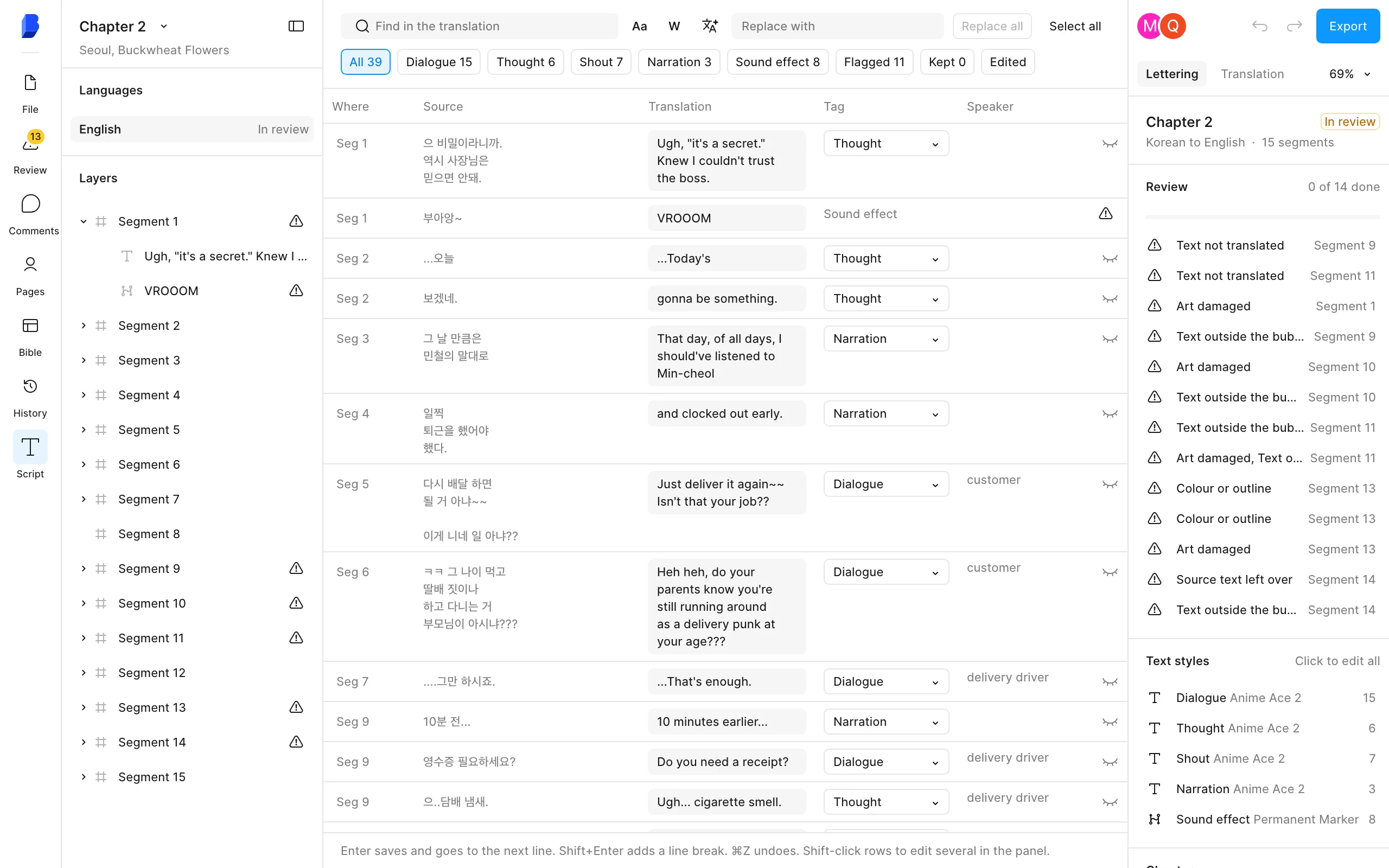
Each series in Bublate has a series bible per target language, with a names list and a glossary. A glossary term set to "always" must be used every time, and every new chapter starts from the same bible. The Bible tab in the editor shows the lines of the open chapter that use each name and term. When you change a term and save, Bublate offers to translate again the lines that use it. The Script view lists every block in reading order and has find and replace across the chapter, with match case and whole word options.
Bublate does not pick the spelling for you or know which spelling a creator prefers. Find and replace works on one chapter at a time, so a back catalogue fix means opening each chapter. A person who reads the language should still check every name before release.
Frequently asked questions
Why is a manhwa character's name spelled differently in different chapters?
Usually because different people or tools translated the chapters without one shared name list. Korean also has two official romanization systems, Revised Romanization and McCune-Reischauer, and many families use their own spelling. Each choice can be correct, but a series must use one form for each name.
Which romanization should I use for Korean names?
Use the creator's or publisher's own spelling if there is one. If not, the Revised Romanization from the National Institute of Korean Language is the official system in South Korea. It writes the family name first and allows a hyphen in the given name, as in Min Yong-ha. Write your choice in the glossary.
Should Japanese names have macrons?
It is a style choice. The SWET Japan Style Sheet says macrons must be used always or never, so Satō in one chapter and Sato in the next is the real error. SWET notes that many magazines leave macrons out because they think macrons confuse readers. Pick one rule, write it in the style sheet and apply it to every name.
Do I have to fix names in old chapters?
No, but decide on purpose. Fixing every chapter gives one spelling everywhere and suits short series and collected editions. A clean change from the next chapter, with a note to readers, suits a long weekly series. Fixing the first arc helps new readers, who start at chapter 1.
Can machine translation keep names consistent?
Only when it gets a glossary. A tool that translates each chapter on its own decides each name again and can spell it differently. Give the tool a fixed name list, check every name before release, and fix the first chapter where a name drifts before it spreads.
Sources
- National Institute of Korean Language, Romanization of Korean · checked
- Library of Congress, ALA-LC Korean Romanization Table (2009, minor update 2025) · checked
- Library of Congress, ALA-LC Japanese Romanization Table (2022) · checked
- SWET, Japan Style Sheet, third edition (PDF) · checked
- Library of Congress, ALA-LC Chinese Romanization Table (2012) · checked
- Library of Congress, Pinyin romanization: Wade-Giles to pinyin correspondence · checked
- David Harper, VIZ editor Holly Fisher on bringing manga to life in English, SKTCHD (26 Feb 2025) · checked