Guide
Free series bible template for manga and webtoon translation
A series bible template is a fill-in file with one section for each decision a translator must keep: characters and how they speak, name spellings, who calls whom what, fixed terms, turning points, style rules and the setting. Download the Markdown copy for any team, or the JSON copy, which has the same fields as the series bible in Bublate and pastes straight into it.
Table of contents
This page explains each field of the template, the decisions behind it, and how to use the file with or without Bublate. For why teams keep a bible at all, read how to keep character voice consistent across 100 chapters. For how Bublate fills and uses one, read inside the series bible.
What is in the template?
| Section | What you write | The mistake it prevents |
|---|---|---|
| 1. Characters | Source and target name, role, age, gender, looks, how they speak, notes, and a register for each other person | A cold character who suddenly sounds friendly. A secret given away early. |
| 2. Names | Every name, place, group and title with one spelling, and other labels the source uses for it | Minjun in chapter 3 and Min-jun in chapter 9 |
| 3. Forms of address | Who calls whom what, as source term and target term | Hyung in one chapter, "brother" in the next |
| 4. Glossary | Fixed terms with a rule: always or prefer, and a note | Awakener, Esper and Hunter for the same word |
| 5. Story so far | A short summary and a table of turning points by chapter | Polite speech after the chapter where two people became friends |
| 6. Style rules | Honorific policy, name order, swearing level, units, sound effects, notes, emphasis | Each translator making a different house rule |
| 7. Setting | Genre, era, place and tone | Modern slang in a palace drama |
The sections and field names are the same as in the series bible that Bublate keeps for each series and target language. A bible made for one tool still works by hand: every field is plain text.
How do you fill the characters section?
Write one block per person, also for people with no name yet. Give those a short label from the text, such as "The masked mercenary", so a later chapter that names them can update one entry.
- How they speak. Write the voice in target-language terms: "curt, formal to adults, swears when scared". A note like "speaks in banmal" helps the translator but not the editor who reads only English.
- Registers. One row for each other person. Korean and Japanese mark the relationship in every verb ending, and English has no such endings. So write the English effect: "casual, teasing, first name only".
- Looks. Hair, build, clothes, marks. The letterer and the checker use it to find who speaks when a balloon has no clear tail.
- Notes. Secrets and their reveal chapter. The translator then avoids a word choice that gives the twist away.
Which romanization and name order should you choose?
Decide once, write it at the top of the Names section, and do not change it mid-series. Readers notice a changed spelling before almost any other fault.
| Source | Common choices | What the reference says |
|---|---|---|
| Korean names | Official romanization (Kim Minjun or Kim Min-jun), or a spelling the creator uses | The National Institute of Korean Language writes the family name first, then a space and the given name. A hyphen between given-name syllables is allowed. Existing spellings may stay. |
| Japanese names | Hepburn with or without macrons (Satō or Sato), family name first or last | The SWET Japan Style Sheet uses Hepburn, says macrons must be used "always or never", prefers Japanese name order where possible, and respects idiosyncratic spellings. |
| Japanese honorific suffixes | Aoi-san, Takeda-senpai, or dropped | The SWET style sheet sets off suffixes with a hyphen: Watanabe-san, Miyo-chan, Ikeda-kun. |
| Chinese names | Pinyin without tone marks, family name first | Write the system you use in the file. Keep an official English name if the publisher has one. |
For the honorific policy itself, see Korean honorifics and Japanese honorifics. The template has a style rule line for it.
Always or prefer: how strict is a glossary term?
Mark each term. Always means the exact target form every time: a power system, a rank, a guild name. Prefer means the default unless the scene needs another word: slang such as 대박, which can be "no way" or "jackpot". Bublate uses the same two rules in every step that reads the bible. A long glossary is easier in a spreadsheet: the translation glossary template is the same section as a CSV file.
How do you keep the story section short?
Write the story so far in three to ten sentences and rewrite it after each arc. Put changes that affect speech in the turning points table, one line each with the chapter: two people move to casual speech, a promotion, a death, a secret that comes out. A translator on chapter 40 then knows that Yuna stopped saying sunbae in chapter 34 without reading 34 chapters.
How do you use the template in Bublate?
- In the library, open the series, or click New series to make one with no chapters yet.
- Click Series bible and pick the target language. Each target language has its own bible.
- Click Import and paste the filled JSON file. JSON in this shape goes in without a model call. A pasted Markdown copy, a character list or a wiki page also works: Bublate reads it and fills the fields.
- Check the entries, then click Save. Nothing is saved before that.
- Upload chapter 1. With Use the series bible on, the first chapter starts from what you wrote. Entries you wrote stay as written in later chapters.
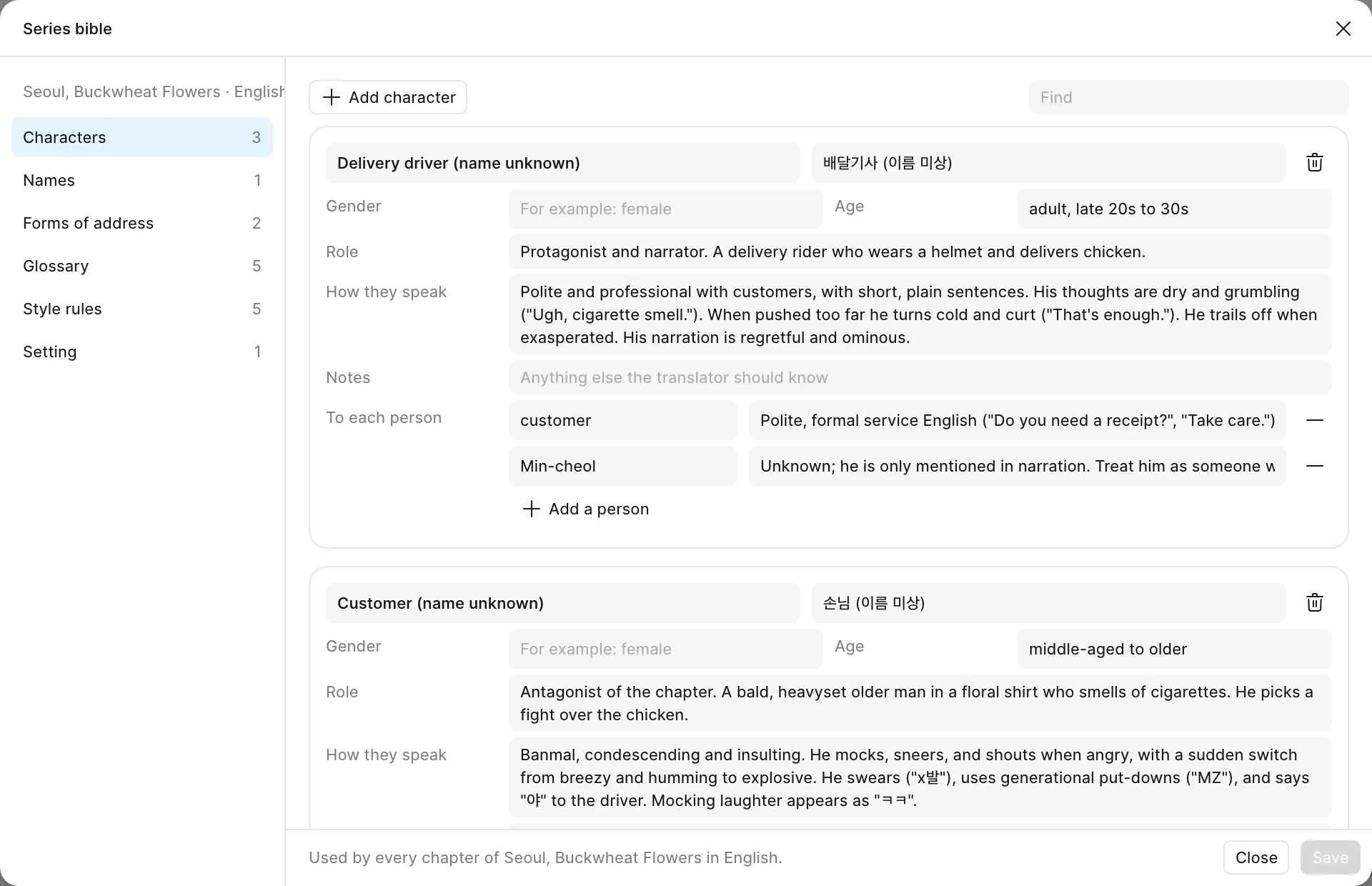
The Export as JSON button in the same window writes the current bible in this shape, so a team can keep a copy next to the chapter files or move it to another series. Fonts, sizes and balloon rules do not belong in the bible: put them in the lettering style sheet.
Who owns and updates the bible?
One person owns it, usually the lead translator or the editor. Others suggest changes. When the owner leaves, the file stays with the series, which is the point of writing it down. A team in Bublate shares one bible per series and language. Before the first release, also run the glossary of terms past the creator if you can: an official spelling from the creator beats any system.
Frequently asked questions
What should a series bible include?
Seven sections: characters (role, age, looks, how they speak, and how they speak to each other person), names with one spelling each, forms of address, a glossary of fixed terms, the story so far with turning points, style rules such as the honorific policy, and the setting. The template has a table or a field for each one.
Is a series bible the same as a glossary?
No. A glossary maps a source term to one target term. A series bible also holds people: who they are, how they talk and how they address each other, and how that changes over the story. Most teams keep both, with the glossary as one section of the bible or as its own sheet.
When should I start the series bible?
Before chapter 1 goes out, or at the latest with it. Every decision you postpone becomes a spelling or an honorific that a later chapter does differently. Add a row in the same pass as the chapter that brings the new name, term or turning point.
Can I import the template into Bublate?
Yes. Fill the JSON copy, open the Bible tab in the editor or Series bible on the series page, click Import and paste the text. JSON in this shape goes in without a model call. A pasted Markdown copy also works: Bublate reads it and fills the fields, and nothing is saved until you click Save.
Which romanization should the bible use for names?
Pick one system and write it at the top of the Names section. For Korean, the official system writes the family name first and allows a hyphen in the given name (Song Na-ri). For Japanese, the SWET Japan Style Sheet uses Hepburn. Keep a spelling the creator or publisher already uses.