Guide
How do you move a comic from a freelance translator and typesetter to Bublate?
Settle the rights and the money first. Then collect the glossary, notes, style sheet and fonts, and put them into one Bublate series bible. Upload the source pages and letter the first pass in Bublate. Keep at least one person who reads both languages to check every chapter. Many teams keep their translator as the reviewer.
Table of contents
This guide is for a creator, a studio or a publisher who pays freelancers per page. Usually that is a translator, plus a typesetter who cleans the art and letters the text. You want to move the series to Bublate, or move the first pass to Bublate and keep the people for the check. Either way, the files and the rights come first. If your translator left on their own, read my translator quit mid-series too.
Why do teams move the first pass off people?
Cost is the reason we can put a number on. An Anime News Network survey feature of 13 November 2026 gives these averages for manga freelancers at US publishers:
| Role | Average rate | Source |
|---|---|---|
| Translator | US$6 a page, up to US$9 for simultaneous releases | Anime News Network |
| Letterer | About US$3 a page, US$9 for simulcast pages | Anime News Network |
| Editor | From US$4.75 a page to US$30 an hour | Anime News Network |
| Korean to English webtoon, translation and typesetting | 160,000 to 220,000 won an episode | Kmong, agency Uptempo |
Moving the first pass to software is a budget choice, not a verdict on the people. Many teams pay the translator to review and edit instead of translating from zero. For the full rate picture, see manga translator pay and typesetter pay.
Who owns the chapters your freelancers already did?
Settle this before you change anything. The US Copyright Office lists translations among derivative works. It says the copyright in a derivative work "covers only the additions, changes, or other new material." So the translator usually owns the translated words, unless a contract says otherwise. US law lets a commissioned translation be a work made for hire only "if the parties expressly agree in a written instrument signed by them" (17 U.S.C. 101).
If you have no such contract, pay what you owe first. Then ask for a signed licence or assignment. It should cover the released chapters, the glossary and the right to edit them. The rights checklist lists what it should say. Ask the letterer which fonts they used and under whose licence.
What carries over, and what does not?
| Item | From your team | In Bublate |
|---|---|---|
| Glossary and name list | A sheet or document | Paste it into Import in the series bible. Set key terms to Always |
| Series notes and character voices | Translator notes, a wiki page, a style guide | Paste into Import. Bublate fills characters, forms of address and style rules |
| Lettering style sheet | Fonts, sizes, bold rules, sound effect policy | Style rules go into the bible. You set sizes and strokes in the editor text tool |
| Fonts | Often bought under the letterer's licence | Upload under Your fonts only if your own licence allows web use. Else pick a comic font in the editor |
| Source pages | Raw pages from the creator | Upload them: PNG, JPG, WebP, a folder, ZIP, CBZ or PDF |
| Clean raws | Pages with the text cleaned out | In the editor, replace a page image with your own clean raw, so Bublate letters on your team's cleaning |
| Layered PSD files | The letterer's working files | Not read on upload. Export flat PNG pages to upload. Bublate can export a layered PSD per page |
| Scripts of released chapters | Text documents | Keep them. Pull the names and terms out of them for the bible. There is no script or translation memory file import |
| Released chapters | Already published | Leave them as they are. Start Bublate at the next chapter |
Translation memory in Bublate starts empty. It learns the lines your team corrects in each chapter and reuses exact matches later. So the old scripts do not fill it. The series bible is what carries your old decisions.
How do you move a series, step by step?
- Settle rights and payment in writing, as above.
- Collect the files in the table into one place you own.
- Sign up. A new account gets 30 free credits, with no card.
- Make the series. In the library, click New series and set the title, source language and format.
- Import the glossary and notes. In the Series bible window, click Import, paste one document at a time, check the fields and click Save. A workspace can run 30 imports a day. The series bible template shows every field.
- Run an overlap chapter. Upload a chapter your team already released. Compare the Bublate pass with the released text line by line, and fix the bible where they differ.
- Invite the people you keep. Give your translator the translator or reviewer role, and your letterer the letterer role. See teams and roles.
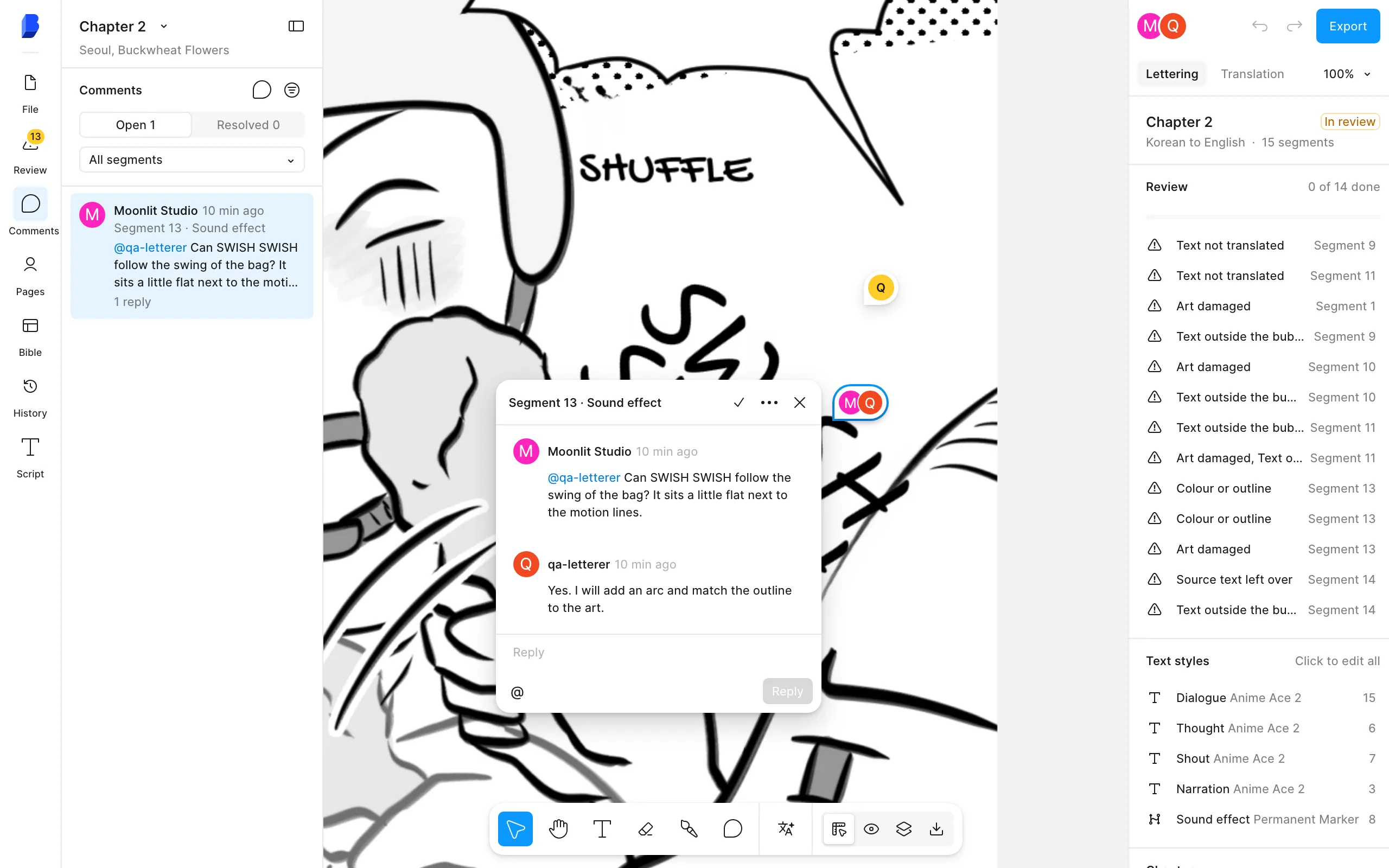
- Start the next new chapter. Read the price before you start. Your team checks it in the editor, comments on the page and marks it done.
- Export with your platform preset, or as a layered PSD per page for a letterer who finishes in Photoshop.
What does each one cost?
Two examples, at the averages above and at Bublate's base prices. They leave out editing and your own review time on both sides.
| Chapter | Freelance team | Bublate |
|---|---|---|
| A 20-page manga chapter | About US$120 for translation and US$60 for lettering, at ANN averages | Up to US$12 (up to $0.60 a page), less when pages hold few text blocks |
| A Korean webtoon episode into English | 160,000 to 220,000 won for translation and typesetting (Uptempo on Kmong) | $3 for up to 20 segments, then $1.50 for each further 10 segments |
Bublate also sells monthly plans (Creator $19 for 100 credits, Studio $69 for 500, Publisher $229 for 2,000) and a pack of 1,000 credits for $149. If you keep a translator as the reviewer, add their rate for reading and editing. See pricing and the translation cost guide.
What does Bublate not do?
- No people for hire. Bublate does not supply translators, letterers or editors.
- No final check. A person who reads both languages still checks names, jokes and register.
- No contract or rights advice. You settle who owns the old translations.
- No PSD import, and no import of scripts or translation memory files.
For the two models side by side, read Bublate vs a localization agency and Bublate vs manual lettering.
Frequently asked questions
Can I keep my translator and still use Bublate?
Yes, and many teams should. Bublate does the first pass of translation and lettering. Invite the translator to the workspace: with the translator role they fix lines, and with the reviewer role they comment without editing. Their corrections go into the translation memory for later chapters.
Do I own the chapters my freelance translator did?
Not always. Under US law the translator owns the translated text, unless they assign it to you. A signed written agreement can also make it a work made for hire. Pay what you owe and ask for a signed licence or assignment before you change teams.
Can I import my old scripts into Bublate?
Not as scripts or a translation memory file. Import in the series bible reads pasted notes, a character list, a wiki page or a style guide, and fills the bible fields. Pull the names, terms and voice notes out of the old scripts and paste those.
Can Bublate letter on my typesetter's clean pages?
Yes. Start the chapter from the source pages, then in the editor replace a page image with your own clean raw. Bublate keeps the text blocks and letters them on your team's cleaned art. A whole chapter of clean raws can replace the images at once.
How much cheaper is Bublate than a freelance team?
At the Anime News Network averages, translating and lettering a 20-page manga chapter costs about US$180. Bublate costs up to US$12 for those 20 pages. That leaves out the time of the person who checks the chapter, which you still need.
Sources
- Coop Bicknell, Manga's Backbone Is Breaking, Anime News Network (13 Nov 2026) · checked
- Kmong, Uptempo English webtoon localization service · checked
- US Copyright Office, Circular 14: Copyright in Derivative Works and Compilations · checked
- 17 U.S.C. 101, definitions: work made for hire (Cornell LII) · checked