Guide
My translator quit mid-series. How do I hand over without breaking the voice?
Collect the decisions before anything else: the glossary, the name list, the series bible and the scripts of every released chapter. Settle in writing who owns the translated text. Then test new translators on chapters that are already out, and compare their work with the released text. A new translator who starts from the old decisions keeps the voice. One who starts blank changes it.
Table of contents
- What should you get from the translator before they go?
- Who owns the chapters they already translated?
- How do you hand over, step by step?
- How do you test a new translator on old chapters?
- What are your options for the next translator?
- Where do you have to decide?
- What does Bublate keep when a translator leaves?
A translator who leaves takes two things with them: the decisions they made and the way they write. You can keep the first if you act in the first week. You can only match the second, by testing the next translator carefully. This page covers both, for a creator, a small studio or a scanlation team that has the rights to the series.
What should you get from the translator before they go?
Ask for all of it at once, in one message, while the person still answers. Most translators are glad to hand over cleanly. Some files may not exist yet. Then the list tells you what to rebuild.
| Item | Why you need it | If it does not exist |
|---|---|---|
| Glossary of names and terms | One approved form per name, place, rank and skill | Build it from the released scripts with the glossary template |
| Series bible | Who each character is, how they talk, who calls whom what | Write it from 3 or 4 chapters with the series bible template |
| Romanization and name order rule | The system behind every spelling | Read it from the released names. See names that change between chapters |
| Scripts of every released chapter | The text to search when a term comes back | Copy the text from the lettered files, which is slow |
| Script of the chapter in progress | Half a chapter is still work you paid for | Start that chapter again with the new translator |
| Open questions and translator notes | Jokes, puns and set-ups not yet paid off | Ask: "What did you plan for later?" |
| Lettering style sheet | Fonts, bold rules, sound effect policy | Use the lettering style sheet template |
| Credit line | How they want to be named on released chapters | Keep the credit as it is on the released chapters |
Who owns the chapters they already translated?
Settle this before the next chapter goes out. The US Copyright Office lists translations among derivative works, and says the copyright in a derivative work "covers only the additions, changes, or other new material". So the author owns the story and the art, and the translator owns the translated words, unless a contract says otherwise.
US law lets a commissioned translation be a work made for hire only "if the parties expressly agree in a written instrument signed by them" (17 U.S.C. 101). If you have no such contract, ask the translator to sign a short licence or assignment that lets you keep the released chapters online, edit them and reuse the glossary. The rights checklist lists what that document should say. Pay what you owe first. A translator who has been paid signs more readily.
How do you hand over, step by step?
- Stop the schedule for one release. A late chapter costs less than a chapter that renames the lead.
- Collect the files in the table above and put them in one shared place that you own, not in the old translator's drive.
- Settle rights and money in writing, as above.
- Fill the gaps. If there is no series bible, read the last 3 or 4 chapters and write one now, while the voice is fresh. Note each character's speech habits and each form of address.
- Test candidates on released chapters (see the next section).
- Run one overlap chapter. The new translator translates a chapter the old one already did. An editor or a reader of both languages compares the two line by line. Each difference is a decision to write down.
- Hand over the next new chapter with the glossary and bible attached, and ask the new translator to add to them, not to start new files.
- Check names in the first 3 new chapters against the glossary before release. The lettering QA checklist has the checks.
How do you test a new translator on old chapters?
A test on a released chapter shows you more than a sample from a new chapter, because you have a reference to compare with. Pick two chapters: one with a lot of dialogue between several characters, and one with action and sound effects. Give the candidate the source pages, the glossary and the bible. Do not give them the released translation.
Pay for the test. An Anime News Network survey of manga freelancers, published on 13 November 2026, put the average translation rate at US$6 a page. A two-chapter test is real work. Then compare the result with the released chapters on these points:
- Names and terms. Did they use the glossary forms every time?
- Forms of address. Does each character still call each other the same thing?
- Voice. Does the rough character still sound rough, and the formal one formal?
- Jokes and set-ups. Did they keep what the old translation set up for later?
- Fit. Will the lines fit the bubbles? Long lines cost the letterer time.
VIZ editor Holly Fisher told SKTCHD in 2025 that VIZ tries to keep the same editors, translators and letterers on a series for consistency. When that is not possible, the files above are what carries the consistency instead.
What are your options for the next translator?
| Option | Voice risk | Cost and speed | Who decides the text |
|---|---|---|---|
| Another freelance translator | Medium, lower with a good bible and an overlap chapter | Per page rates, depends on their schedule | The translator, checked by you |
| An agency or studio | Medium, the person can change between chapters | Usually higher, with a contract | The agency's editor |
| Machine first pass plus an editor | Depends on the glossary and the editor | Lower cost, fast first pass, the editor's time is the limit | The editor |
| A team member who reads the language | Low on decisions, unknown on style | Their time | That person |
| Pause the series | None | Readers wait | You |
Where do you have to decide?
- Keep or change old choices. A new translator may dislike a name or an honorific policy. Changing it splits the series in two. If you change it, follow what to do when a name changes mid-series.
- Retranslate or keep the back catalogue. Keeping it is cheaper. Retranslating gives one voice, but readers who reread will notice.
- Tell readers or not. A short note in the episode credits is enough. A sudden change in tone with no note makes readers guess.
What does Bublate keep when a translator leaves?
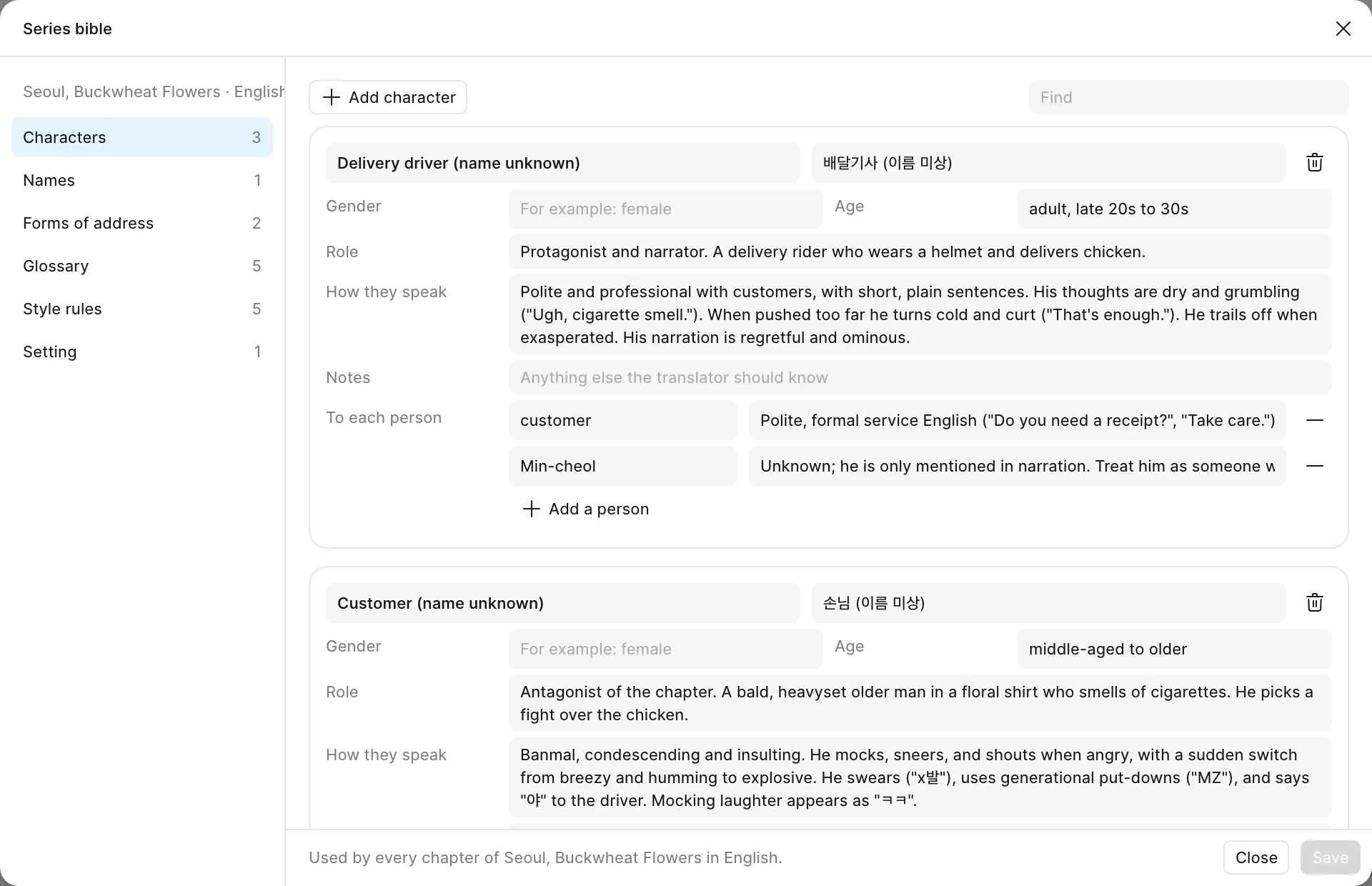
In Bublate the decisions live with the series, not with a person. The series bible holds characters, names, forms of address, the glossary and style rules, one per series and target language, and carries from chapter to chapter. Import takes a pasted character list, a Markdown file or the JSON template, so an old translator's notes go in once. Translation memory keeps lines people corrected and reuses exact matches in later chapters. Edit history shows who changed which line and when, and Changes since the first pass lists every edited line of a chapter.
To bring in the new person, invite them to the workspace with the translator role. See teams and roles. A reviewer role can comment and flag without editing. Bublate does not choose between two translators or judge which voice is right. A person who reads both languages still checks every chapter.
Frequently asked questions
Can I keep publishing chapters my old translator did after they quit?
Only if you have the right to. The translator owns the copyright in the translated text unless a contract says otherwise. If you have no written agreement, ask them to sign a short licence or assignment that covers the released chapters. Most translators agree when they have been paid what they are owed.
How do I keep character names the same with a new translator?
Give the new translator the glossary before the first page, with one approved form per name and the romanization rule. Ask them to use it every time and to add new names to it. Check every name in the first three new chapters against the glossary before release.
How do I test a new manga translator?
Give them the source pages of two chapters that are already released, with the glossary and the series bible, but not the released translation. Pay for the test. Compare names, forms of address, each character's voice and how well the lines fit the bubbles against the released text.
Should I retranslate earlier chapters with the new translator?
Usually not. It costs as much as new chapters and readers who reread will see the change. Fix only names and terms that the new glossary changes, and keep the rest. A full retranslation makes sense for a print or collected edition, where the whole book should read as one voice.
Sources
- US Copyright Office, Circular 14: Copyright in Derivative Works and Compilations · checked
- 17 U.S.C. 101, definitions: work made for hire (Cornell LII) · checked
- Coop Bicknell, Manga's Backbone Is Breaking, Anime News Network (13 Nov 2026) · checked
- David Harper, VIZ editor Holly Fisher on bringing manga to life in English, SKTCHD (26 Feb 2025) · checked