Guide
What is machine translation post-editing, and how do you post-edit a comic?
Machine translation post-editing (MTPE) means a person corrects a machine translation until it reaches an agreed quality. Light post-editing fixes only errors that change the meaning. Full post-editing also fixes style, terms and flow, so the result reads like a human translation. A published comic needs full post-editing, plus checks for speakers, names, sound effects and bubble fit.
Table of contents
Most comic translation tools now give a first draft in minutes. The draft is not the release. Someone who reads both languages still has to check every line against the art, fix what the machine got wrong, and make the text fit the bubbles. The translation industry calls that work machine translation post-editing, or MTPE. This page explains the terms, the two levels, and the checks that matter on a comic page.
What does MTPE mean?
MTPE stands for machine translation post-editing. The Wikipedia article on post-editing defines it as "the process whereby humans amend machine-generated translation to achieve an acceptable final product", and calls the person who does it a post-editor. Post-editing is different from editing, which improves a text a human translated. The international standard for the work is ISO 18587:2017, "Translation services: Post-editing of machine translation output: Requirements", published in 2017.
What is the difference between light and full post-editing?
Wikipedia sums it up: light post-editing aims at "making the output simply understandable", and full post-editing at making it "also stylistically appropriate". A 2020 paper by Mara Nunziatini and Lena Marg of Welocalize, given at the EAMT conference, summarizes the common guidelines. Full post-edited output "should be close to human translation quality", with attention to grammar and spelling, terminology, style and accuracy. Light post-editing "should aim at fixing major/blatant errors only, while minor issues are acceptable". The same paper finds these definitions too vague to apply as they are, which is why teams agree the level for each project.
| Light post-editing | Full post-editing | |
|---|---|---|
| Goal | The reader understands it | It reads like a human translation |
| Fixes | Wrong meaning, missing lines | Meaning, terms, style, flow, spelling, punctuation |
| Leaves | Awkward but correct lines | Nothing it can fix |
| Fits a comic for | An internal read, a pitch to a licensor, checking the plot | A published chapter |
| Comic checks | Speakers and plot | Speakers, names, honorifics, voice, sound effects, bubble fit |
Why does a comic need more than a text post-edit?
A comic line has no meaning without its panel. A post-editor who reads the script alone misses errors that only the page shows.
- Speaker and gender. Korean and Japanese often leave out the subject, so a machine can guess the wrong speaker, or "he" for "she". The art shows who speaks.
- Forms of address. Honorifics and titles show how two characters relate. One wrong form changes the relationship. See Korean honorifics.
- Names and terms. A tool that translates chapter by chapter can spell a name two ways. See why character names change between chapters.
- Voice. Each character needs the same voice in every chapter. See how to keep character voice consistent.
- Sound effects. A sound effect has no single right word, and it must suit the size and style of the art.
- Bubble fit. A correct line that is too long for its bubble is still wrong on the page. Shorten it or re-letter it.
- Text in the art. Signs, phone screens and notes are easy to miss in a script.
Our own test shows why the check is not optional. In a blind test of 38 Korean webtoon lines, the model Bublate uses in production got the top score of 3 in 67% of the judges' scores, and 3 of its 76 scores were 0 or 1. Every model in the test scored lower on sound effects than on dialogue. The data is on the translation model test page.
How do you post-edit a machine-translated chapter?
- Agree the level first. Light or full, plus the house rules for honorifics, names and sound effects. Write them into a series bible and a glossary.
- Read the source chapter. Know the story of the chapter before you change a line.
- Check each line against its panel. Speaker, tone and meaning, in reading order.
- Fix terms and names from the glossary. Then search the chapter for every name, so none is spelled two ways.
- Fix voice and style. Contractions, slang and register for each character.
- Check sound effects. Pick a word that suits the scene and the art, or keep the original with a caption.
- Check the lettered page. Bubble fit, line breaks, hyphens and text in the art. Use the lettering QA checklist.
- Record what you changed. The next chapter should start from your fixes, not from the same machine errors.
Is machine translation allowed on comic platforms?
Rules differ by platform, and they change. Read whether machine translation is allowed on WEBTOON and Tapas before you publish a post-edited chapter. Only translate work you own or have the rights to translate. See the rights checklist.
How much does post-editing cost?
We found no published rate for post-editing comics. For the rates of full translation and lettering, with sources, see do manga translators get paid. A post-edit rate depends on the quality of the draft, the level agreed and who letters the page, so agree it per project.
How does Bublate support post-editing?
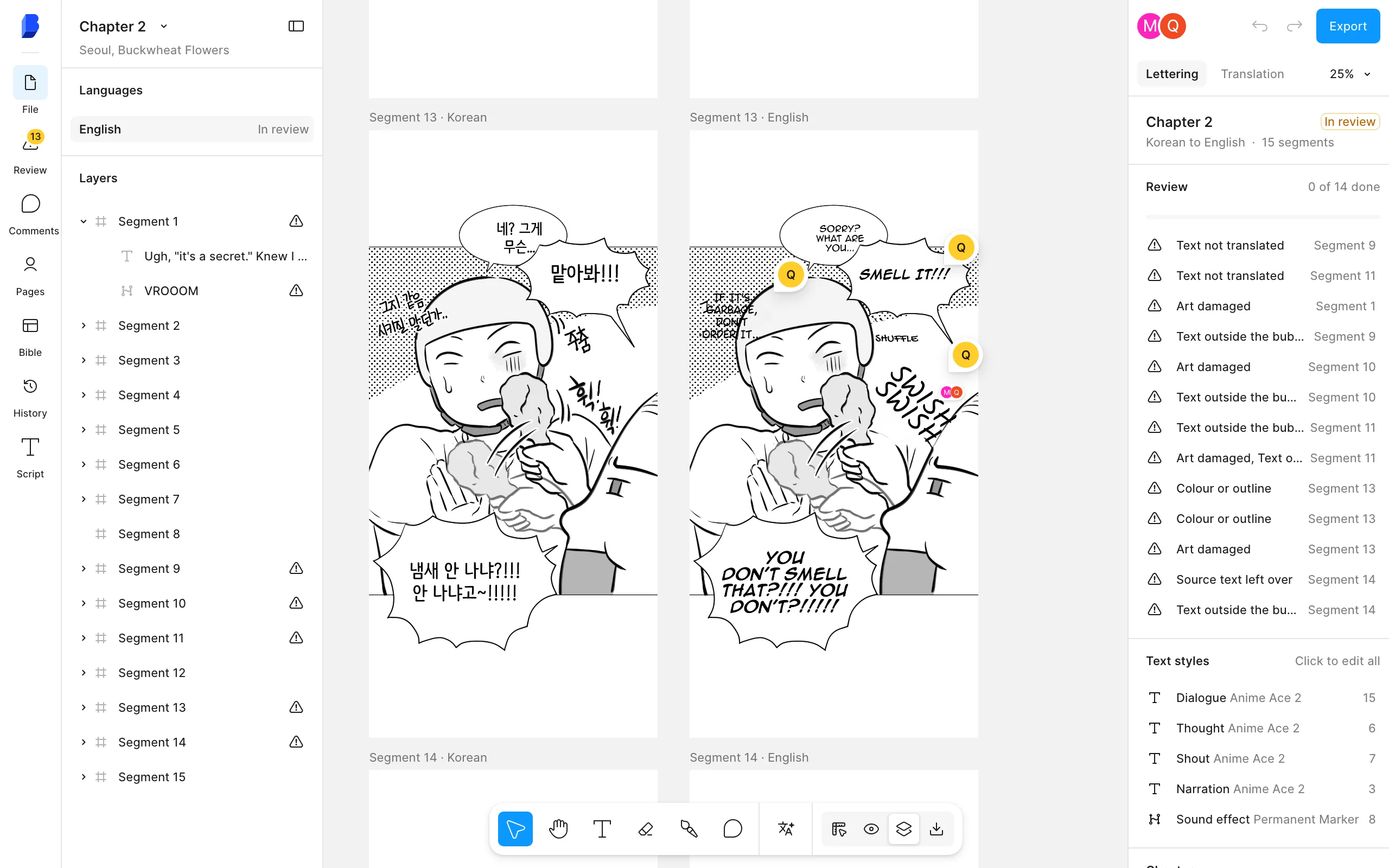
Bublate gives the first pass and the tools for a full post-edit in the same place. The pipeline reads each block with its speaker, the person it is said to and its tone, translates with the series bible, polishes, letters the page and runs a visual check. You then edit the lettered page.
- Review flags. The visual check marks possible faults as pins on the page. Each flag is a lead, so you resolve or dismiss it.
- Source on demand. Hold S to see the source page, or use side by side mode with one scroll and zoom.
- Script view. Every block in reading order as a table, with find and replace across the chapter.
- Translate again with a note on one block, such as "shorter" or "more formal".
- Changes since the first pass. A list of every changed line with the source, the first pass, the current text, who changed it and when, as CSV too.
- Translation memory. When you mark a chapter done, Bublate saves the dialogue lines you changed and sends them to the next chapter as earlier translations to prefer.
- Roles. A reviewer can view, flag and comment without editing. See teams and roles.
A webtoon chapter costs $3 and a manga page costs up to $0.60, and a new account gets 30 free credits. See how to edit a page and pricing.
Frequently asked questions
What does MTPE mean in translation?
MTPE means machine translation post-editing. A machine translates the text first, and then a person who reads both languages corrects the output until it reaches an agreed quality. The person is called a post-editor. The ISO 18587:2017 standard sets requirements for the work.
What is the difference between light and full post-editing?
Light post-editing makes the output understandable and fixes only major errors. Full post-editing also fixes style, terms and flow, so the result reads like a human translation. The line between them is not fixed, so teams agree the level for each project.
Can you publish a machine-translated manga without post-editing?
You should not. In a Bublate test of 38 Korean webtoon lines, even the best model got some scores of 0 or 1, and every model scored lower on sound effects. Comic lines also depend on the art, so a person must check speakers, names and bubble fit before release.
Is post-editing faster than translating from scratch?
Often, when the draft is good and the post-editor knows the series. A weak draft can take longer to fix than a new translation. The gain depends on the language pair, the genre and the rules in the glossary, so test it on one chapter first.
Do I need to know the source language to post-edit?
Yes. A post-editor checks the translation against the source text. A person who reads only the target language can smooth the style, but cannot see a wrong meaning, a wrong speaker or a missed joke. That work is proofreading, not post-editing.
Does Bublate learn from my edits?
Yes, through translation memory. When you mark a chapter done, Bublate saves the dialogue lines you changed, per workspace, language and series. The next chapter gets them as earlier translations to prefer. Settings shows the memory and can clear it.
Sources
- Wikipedia, Postediting (light and full post-editing, ISO 18587:2017) · checked
- Mara Nunziatini and Lena Marg, Machine Translation Post-Editing Levels: Breaking Away from the Tradition and Delivering a Tailored Service, EAMT 2020 (PDF) · checked
- Bublate, Translation model test: 10 models on Korean webtoon lines · checked