Chinese (Simplified) to Korean
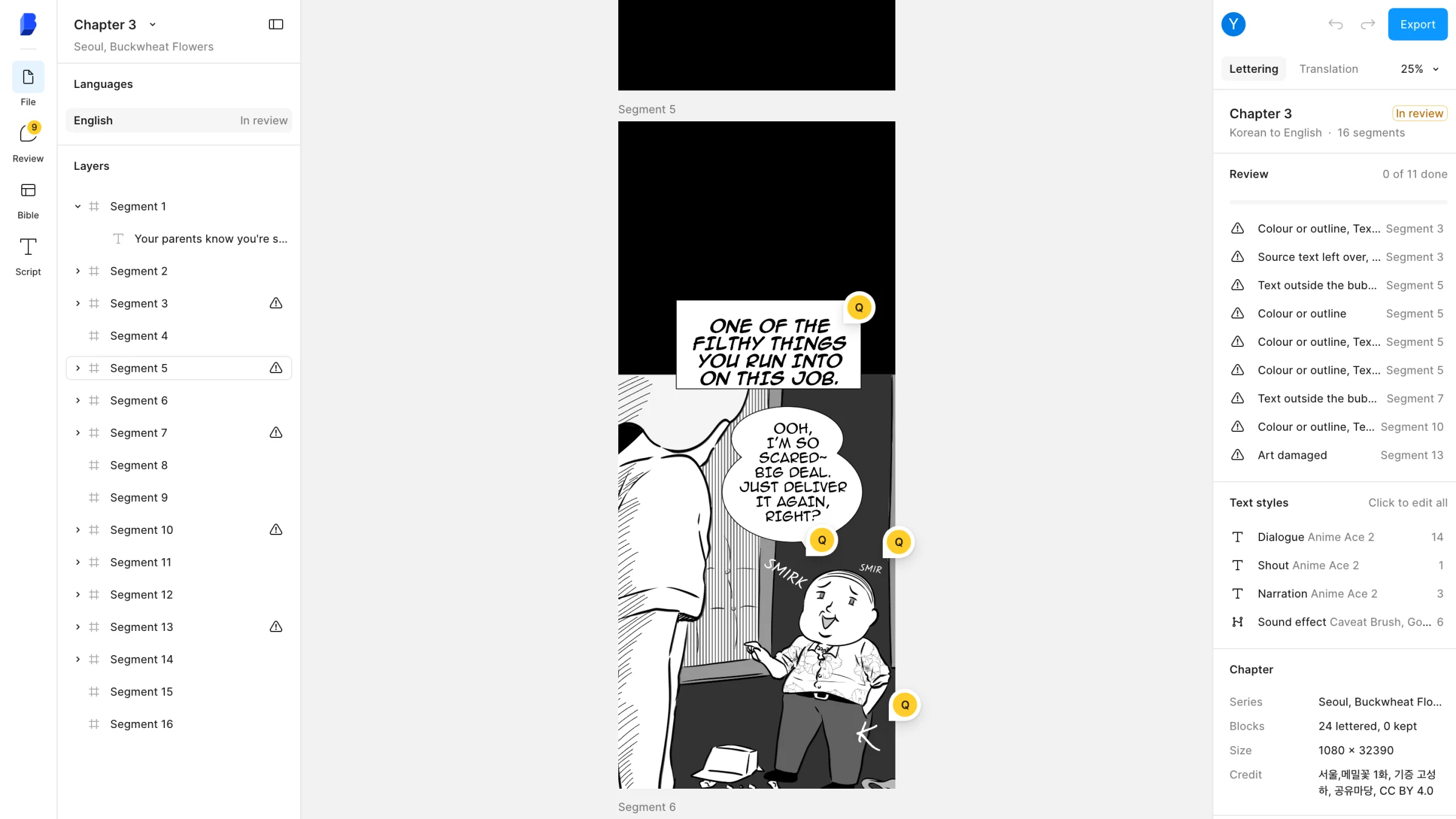
Translate Simplified Chinese manhua into Korean
Bublate translates Simplified Chinese manhua into Korean and letters every page. 砰 (pēng) becomes 쾅 (kwang). Each Korean line is re-fitted to balloons drawn for Simplified Chinese. Korean text is 19% wider than Simplified Chinese at one font size.
Korean text is 19% wider than Simplified Chinese at one font size. 轰 (hōng) becomes 펑 (peong). A title like 师兄 (shīxiōng) meets Korean titles like 선배 (seonbae). 咯噔 (gēdēng) becomes 뚜벅뚜벅 (ttubeok-ttubeok). A kin word like 大哥 (dàgē) can become 오빠 (oppa). 咚 (dōng) becomes 똑똑 (ttok-ttok).
What changes from Simplified Chinese to Korean
Script, 19% more line width and forms of address change from Simplified Chinese to Korean.
Han (Simplified) to Hangul
Simplified Chinese is written in the Han (Simplified) script and Korean in the Hangul script. Korean puts spaces between words, but lines usually break between syllables, with no hyphen. Chinese puts no spaces between words, and lines wrap between characters. Simplified Chinese has fewer characters, with simpler shapes, than Traditional Chinese. Bublate breaks Korean lines at the spaces between words.
19% longer lines
Korean text is about 19% wider than the same Simplified Chinese text at one font size (FLORES-200). It has 22% more characters. A Korean line needs more room than the Simplified Chinese line it replaces. Bublate fits each balloon by setting the Korean text on more lines or at a smaller size, and you check the tight ones in the editor.
"You" and titles
Simplified Chinese chooses between 你 and 您. Korean 반말 is the plain speech of close friends. It neither raises nor lowers the listener. Simplified Chinese titles such as 师兄 (shīxiōng) and 师姐 (shījiě) meet Korean titles such as 선배 (seonbae) and 님 (nim). Kin words for friends: Simplified Chinese 大哥 (dàgē) and 姐姐 (jiějie), Korean 오빠 (oppa) and 언니 (eonni).
Simplified Chinese comics for Korean readers
Japan took 49.5% of Korean webtoon exports in 2024, and North America took 21.0%. Platforms in Korean include Lezhin Comics, RIDI and Bomtoon.
Kuaikan Manhua said in 2019 that it had more than 170 million users and more than 40 million monthly users. Tencent Comics carries a Chinese edition of the Japanese manga Haikyu. Simplified Chinese comics come from Dongman Manhua and Kuaikan Manhua.
Korean readers search for "webtoon naver", "webtoon korea" and "웹툰 보기" (Google autocomplete, 2026-11-22).
Side by side
| Chinese (Simplified) | Korean | |
|---|---|---|
| Script | Han (Simplified) | Hangul |
| Spaces between words | No | Yes |
| Line width against English (same size) | 66% | 78% |
| Line breaks in Bublate | Between phrases | At spaces |
| Characters against English | 38% | 46% |
| Digits | 0 to 9, 〇一二三 | 0 to 9 |
| Titles | 师兄 (shīxiōng), 师姐 (shījiě), 大人 (dàrén) | 선배 (seonbae), 님 (nim), 씨 (ssi) |
| Kin words used for friends | 大哥 (dàgē), 姐姐 (jiějie), 叔叔 (shūshu) | 오빠 (oppa), 언니 (eonni), 누나 (nuna) |
| Words for comics | 条漫 (tiáomàn) | 웹툰 (webtun) |
| Words for comics | 国漫 (guómàn) | 만화책 (manhwachaek) |
| Familiar and polite "you" | 你, 您 | No pair recorded |
| Heavy impact | 砰 (pēng) | 쾅 (kwang) |
| Explosion | 轰 (hōng) | 펑 (peong) |
| Crash | 哗啦 (huālā) | 와장창 (wajangchang) |
| Heartbeat | 怦怦 (pēngpēng) | 두근두근 (dugeun-dugeun) |
| Footsteps | 咯噔 (gēdēng) | 뚜벅뚜벅 (ttubeok-ttubeok) |
| Knock | 咚 (dōng) | 똑똑 (ttok-ttok) |
| Laughter | 哈哈 (hāhā) | 하하 (haha) |
| Gulp | 咕嘟 (gūdū) | 꿀꺽 (kkulkkeok) |
| Fast swoosh | 嗖 (sōu) | 휙 (hwik) |
| Splash | 扑通 (pūtōng) | 풍덩 (pungdeong) |
| Dog | 汪汪 (wāngwāng) | 멍멍 (meongmeong) |
| Cat | 喵 (miāo) | 야옹 (yaong) |
| Rooster | 喔喔 (wōwō) | 꼬끼오 (kkokkio) |
| Sneeze | 阿嚏 (ātì) | 에취 (echwi) |
Simplified Chinese sound effects in Korean
14 sounds with a word on both sides.
砰 to 쾅
砰 (pēng) becomes 쾅 (kwang) (a heavy impact), 轰 (hōng) becomes 펑 (peong) (an explosion), 哗啦 (huālā) becomes 와장창 (wajangchang) (a crash) and 怦怦 (pēngpēng) becomes 두근두근 (dugeun-dugeun) (a heartbeat). In that Chinese edition, the translated sound words changed from hand drawing to computer fonts. Korean editions of Japanese manga tend to re-letter the sound effects in Korean. American graphic novels in Korea usually get only a small caption.
Korean punctuation
The 2015 Korean punctuation rules cover only horizontal writing, because ordinary documents are now rarely vertical. On the Simplified Chinese side: Simplified Chinese may stack exclamation marks for a huge or growing sound, up to three, as in 轰!!
Page order and text direction
Korean manhwa in print read from left to right, like English books. Korean editions of Japanese manga keep the Japanese right to left order, a rule since the mid-1990s.

Lettering Korean
Korean has no upper and lower case. So a Korean balloon has no all-caps rule. Kuaikan Manhua asked for color vertical strips 1280 px wide in its 2019 contest. Each strip was at most 15,000 px tall. Most publications in mainland China set simplified characters horizontally. A few use vertical text.
Bublate letters Korean with fonts made for the Hangul script. See the Chinese sound effect dictionary, manga, manhwa and manhua, bubble font size calculator and how to letter comics.
Sources
- r12a, Korean orthography notes · checked
- r12a, Chinese orthography notes · checked
- FLORES-200 devtest, 1,012 sentences in 200 languages (NLLB Team, CC BY-SA 4.0), measured by Bublate · checked
- Wikipedia: Manhwa (reading direction) · checked
- 위키백과: 일본 만화 (Korean editions and binding) · checked
- 표준국어대사전: 반말 · checked
- Wiktionary: 師兄 (Chinese) · checked
- Wiktionary: 師姐 (Chinese) · checked
- Wiktionary: 大人 (Chinese) · checked
- 표준국어대사전: 선배 (先輩) · checked
- 표준국어대사전: -님 · checked
- Wiktionary: 님 (Korean) · checked
- Wiktionary: 씨 (Korean, usage notes) · checked
- Wiktionary: 大哥 (Chinese) · checked
- Wiktionary: 姐姐 (Chinese) · checked
- Wiktionary: 叔叔 (Chinese) · checked
- Wiktionary: 오빠 (Korean) · checked
- Wiktionary: 언니 (Korean) · checked
- Wiktionary: 누나 (Korean) · checked
- CC-CEDICT (MDBG): 砰 · checked
- 표준국어대사전: 쾅 · checked
- CC-CEDICT (MDBG): 轰 · checked
- 표준국어대사전: 펑 · checked
- CC-CEDICT (MDBG): 哗啦 · checked
- 표준국어대사전: 와장창 · checked
- CC-CEDICT (MDBG): 怦怦 · checked
- 표준국어대사전: 두근두근 · checked
- CC-CEDICT (MDBG): 咯噔 · checked
- 표준국어대사전: 뚜벅뚜벅 · checked
- CC-CEDICT (MDBG): 咚 · checked
- Wiktionary: 똑똑 (Korean) · checked
- CC-CEDICT (MDBG): 哈哈 · checked
- 표준국어대사전: 하하 · checked
- Wiktionary: 咕嘟 (Chinese) · checked
- 표준국어대사전: 꿀꺽 · checked
- CC-CEDICT (MDBG): 嗖 · checked
- 표준국어대사전: 휙 · checked
- CC-CEDICT (MDBG): 扑通 · checked
- 표준국어대사전: 풍덩 · checked
- CC-CEDICT (MDBG): 汪汪 · checked
- 표준국어대사전: 멍멍 · checked
- CC-CEDICT (MDBG): 喵 · checked
- 표준국어대사전: 야옹 · checked
- CC-CEDICT (MDBG): 喔 · checked
- 표준국어대사전: 꼬끼오 · checked
- CC-CEDICT (MDBG): 阿嚏 · checked
- 표준국어대사전: 에취 · checked
- 최원, 만화규장각: 만화책 편집자의 속사정 (2021) · checked
- 共立女子大学 exchange report: 日本漫画におけるオノマトペ翻訳研究 (ハイキュー‼ Chinese edition, 2025, PDF) · checked
- Unicode CLDR 49.0.0: delimiters and number symbols · checked
- 국립국어원: 한글 맞춤법 부록, 문장 부호 (2015) with commentary · checked
- GB/T 15834-2011 标点符号用法 (text on a 上海健康医学院 page) · checked
- W3C: Requirements for Hangul Text Layout and Typography (klreq) · checked
- 网易新闻: 头奖8万元!快看漫画条漫大赛火热启动 (2019-01-10) · checked
- W3C: Requirements for Chinese Text Layout (clreq) · checked
- 한국콘텐츠진흥원: 2025 웹툰산업 실태조사 (press release, 2025-12-29) · checked
- 레진코믹스 · checked
- 리디 웹툰 · checked
- 봄툰 · checked
- 咚漫漫画 · checked
- 快看漫画 · checked
- 维基百科: Webtoon (又称条漫) · checked
- 표준국어대사전: 웹툰 · checked
- Wiktionary: 國漫 (Chinese) · checked
- 표준국어대사전: 만화책 · checked
Related
Learn more
Chinese (Simplified) to Japanese
Translate Simplified Chinese manhua into Japanese: script, length, forms of address and sound effects compared.
Learn moreChinese (Simplified) to Chinese (Traditional)
Translate Simplified Chinese manhua into Traditional Chinese: script, length, forms of address and sound effects compared.
Learn moreChinese (Traditional) to Korean
Translate Traditional Chinese manhua into Korean: script, length, forms of address and sound effects compared.
Learn moreQuestions
How do I translate Simplified Chinese manhua into Korean?
Upload the Simplified Chinese pages and pick Korean. Bublate letters each balloon in Hangul script, and 哗啦 (huālā) becomes 와장창 (wajangchang), 怦怦 (pēngpēng) becomes 두근두근 (dugeun-dugeun). A webtoon chapter costs $3, a manga page up to $0.60, with 30 free credits.
How are Simplified Chinese forms of address handled in Korean?
Simplified Chinese chooses between 你 and 您. Korean 반말 is the plain speech of close friends. It neither raises nor lowers the listener. Simplified Chinese titles such as 师兄 (shīxiōng) and 师姐 (shījiě) meet Korean titles such as 선배 (seonbae) and 님 (nim).
What happens to Simplified Chinese sound effects in Korean?
Each one gets a Korean word for the same sound: 怦怦 (pēngpēng) becomes 두근두근 (dugeun-dugeun) (a heartbeat), 咯噔 (gēdēng) becomes 뚜벅뚜벅 (ttubeok-ttubeok) (footsteps), 咚 (dōng) becomes 똑똑 (ttok-ttok) (a knock), 哈哈 (hāhā) becomes 하하 (haha) (laughter) and 咕嘟 (gūdū) becomes 꿀꺽 (kkulkkeok) (a gulp). Korean editions of Japanese manga tend to re-letter the sound effects in Korean. American graphic novels in Korea usually get only a small caption.
Does Korean text fit balloons drawn for Simplified Chinese?
Korean text is about 19% wider than the same Simplified Chinese text at one font size (FLORES-200). It has 22% more characters. A Korean line needs more room than the Simplified Chinese line it replaces. Bublate fits each balloon by setting the Korean text on more lines or at a smaller size, and you check the tight ones in the editor.