Chinese (Simplified) to Chinese (Traditional)
Translate Simplified Chinese manhua into Traditional Chinese
Bublate translates Simplified Chinese manhua into Traditional Chinese and letters every page. 滴答 (dīdā) becomes 滴答 (dīdā). 你 and 您 map to 你 and 您. Each Traditional Chinese line is re-fitted to balloons drawn for Simplified Chinese. Traditional Chinese text is 4% narrower than Simplified Chinese at one font size.
Traditional Chinese text is 4% narrower than Simplified Chinese at one font size. 嘘 (xū) becomes 噓 (xū). 你 and 您 map to 你 and 您. A title like 老师 (lǎoshī) meets Traditional Chinese titles like 前輩 (qiánbèi). 喔喔 (wōwō) becomes 喔喔 (wōwō). A kin word like 大哥 (dàgē) can become 阿姨 (āyí).
What changes from Simplified Chinese to Traditional Chinese
Script, 4% less line width and forms of address change from Simplified Chinese to Traditional Chinese.
Han (Simplified) to Han (Traditional)
Simplified Chinese is written in the Han (Simplified) script and Traditional Chinese in the Han (Traditional) script. Chinese puts no spaces between words, and lines wrap between characters. Chinese puts no spaces between words, and lines wrap between characters. Simplified Chinese has fewer characters, with simpler shapes, than Traditional Chinese. Traditional Chinese has more characters, with fuller shapes, than Simplified Chinese. Bublate breaks Traditional Chinese lines at phrase boundaries (BudouX), because Traditional Chinese has no spaces between words.
4% shorter lines
Traditional Chinese text is about 4% narrower than the same Simplified Chinese text at one font size (FLORES-200). It has 6% fewer characters. Most Traditional Chinese lines fit the Simplified Chinese balloons at a similar size. Bublate re-fits each balloon to the new text.
"You" and titles
Both languages mark respect in the word for "you": Simplified Chinese 你 or 您, Traditional Chinese 你 or 您. Keep the level the Simplified Chinese characters use for each other. Simplified Chinese titles such as 老师 (lǎoshī) and 前辈 (qiánbèi) meet Traditional Chinese titles such as 前輩 (qiánbèi) and 師兄 (shīxiōng). Kin words for friends: Simplified Chinese 大哥 (dàgē) and 姐姐 (jiějie), Traditional Chinese 阿姨 (āyí) and 大哥 (dàgē).
Simplified Chinese comics for Traditional Chinese readers
Chinese-language comics were 8.24% of those Taiwan titles, and Korean comics were 2.68%. Platforms in Traditional Chinese include Sharp Point, Kadokawa Taiwan and BOOK☆WALKER Taiwan.
Kuaikan Manhua said in 2019 that it had more than 170 million users and more than 40 million monthly users. Tencent Comics carries a Chinese edition of the Japanese manga Haikyu. Simplified Chinese comics come from Dongman Manhua and Kuaikan Manhua.
Traditional Chinese readers search for "webtoon漫畫", "webtoon 代幣" and "條漫是什麼" (Google autocomplete, 2026-11-22).
Side by side
| Chinese (Simplified) | Chinese (Traditional) | |
|---|---|---|
| Script | Han (Simplified) | Han (Traditional) |
| Line width against English (same size) | 66% | 63% |
| Quotation marks | “ ” | 「 」 |
| Characters against English | 38% | 36% |
| Titles | 老师 (lǎoshī), 前辈 (qiánbèi), 师兄 (shīxiōng) | 前輩 (qiánbèi), 師兄 (shīxiōng), 大人 (dàrén) |
| Kin words used for friends | 大哥 (dàgē), 姐姐 (jiějie), 叔叔 (shūshu) | 阿姨 (āyí), 大哥 (dàgē), 姐姐 (jiějie) |
| Words for comics | 连环画 (liánhuánhuà) | 條漫 (tiáomàn) |
| Words for comics | 拟声词 (nǐshēngcí) | 連環畫 (liánhuánhuà) |
| Silence | 嘘 (xū) | 噓 (xū) |
| Sneeze | 阿嚏 (ātì) | 哈啾 (hājiū) |
| Kiss | mua | 啾 (jiū) |
| Explosion | 轰 (hōng) | 轟 (hōng) |
| Crash | 哗啦 (huālā) | 嘩啦 (huālā) |
Simplified Chinese sound effects in Traditional Chinese
14 sounds with a word on both sides.
滴答 to 滴答
滴答 (dīdā) becomes 滴答 (dīdā) (a ticking clock), 嘘 (xū) becomes 噓 (xū) (silence), 汪汪 (wāngwāng) becomes 汪汪 (wāngwāng) (a dog) and 喵 (miāo) becomes 喵 (miāo) (a cat). In that Chinese edition, the translated sound words changed from hand drawing to computer fonts. A 1997 Taiwan edition of a Taiyo Matsumoto book kept the drawn kana with a small gloss. The 2017 edition redrew each one by hand in Chinese.
Traditional Chinese punctuation
Quotation marks change from “ ” in Simplified Chinese to 「 」 in Traditional Chinese. In Taiwan and Hong Kong, the middle dot (·) takes a full character width. In mainland China it takes half. On the Simplified Chinese side: Simplified Chinese may stack exclamation marks for a huge or growing sound, up to three, as in 轰!!
Page order and text direction
Most print comics in Taiwan are Japanese manga in translation. Their Traditional Chinese editions keep the right to left page order. Taiwan and Hong Kong have no rule for text direction. Leisure books for young readers, such as comics, mostly use vertical text. Bublate sets Traditional Chinese in horizontal lines.

Lettering Traditional Chinese
Traditional Chinese editions of Japanese manga keep the vertical text of the Japanese layout. Kuaikan Manhua asked for color vertical strips 1280 px wide in its 2019 contest. Each strip was at most 15,000 px tall. Most publications in mainland China set simplified characters horizontally. A few use vertical text.
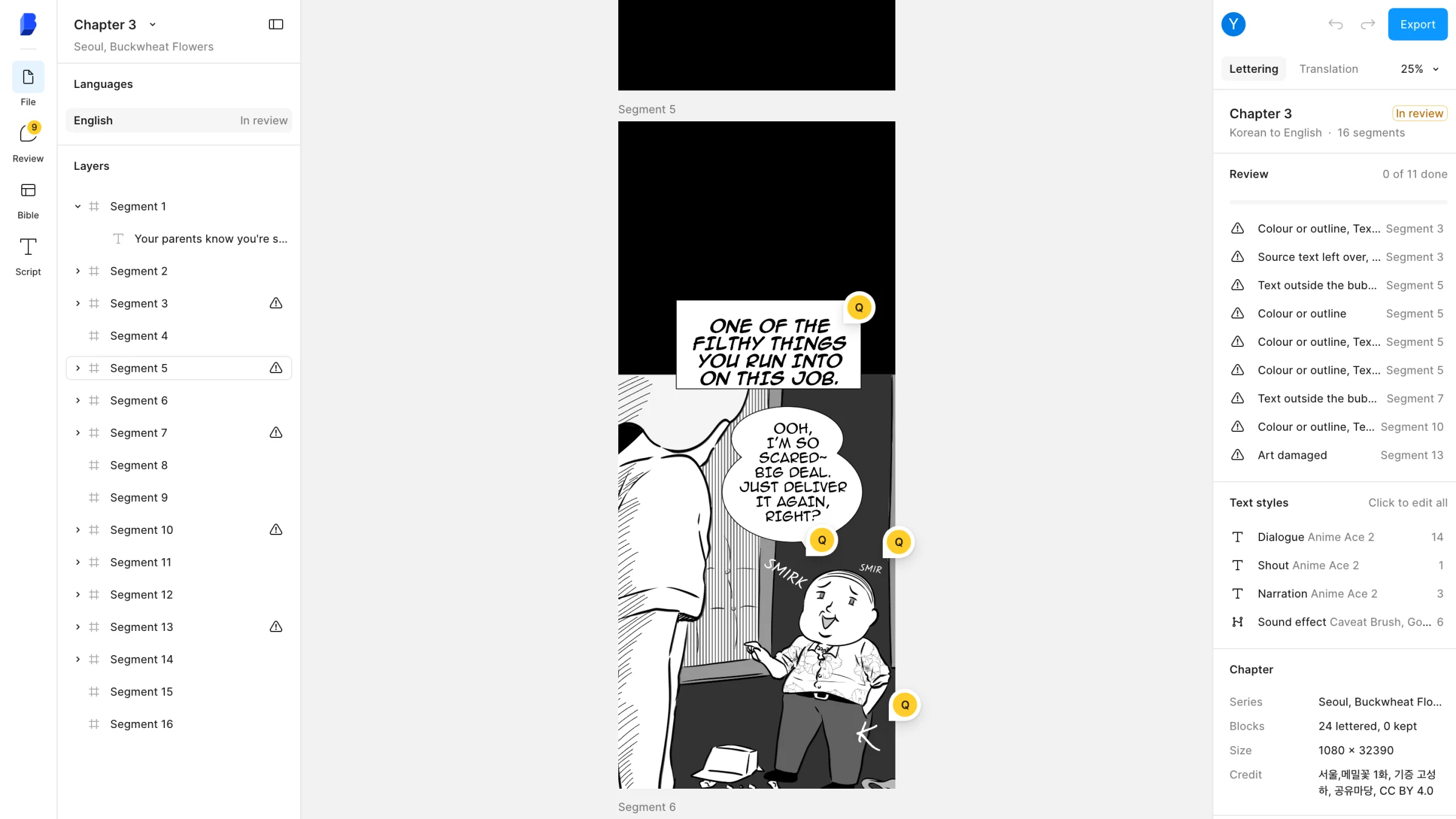
Bublate letters Traditional Chinese with fonts made for the Han (Traditional) script. See the Chinese sound effect dictionary, manga, manhwa and manhua, bubble font size calculator and how to letter comics.
Sources
- r12a, Chinese orthography notes · checked
- FLORES-200 devtest, 1,012 sentences in 200 languages (NLLB Team, CC BY-SA 4.0), measured by Bublate · checked
- 維基百科: 縱書與橫書 (漫畫 and 臺灣、香港 sections) · checked
- 行政院 (文化部 briefing, 2019): 漫畫作品國別分布 2017 (PDF) · checked
- Wiktionary: 老師 (Chinese) · checked
- Wiktionary: 前輩 (Chinese) · checked
- Wiktionary: 師兄 (Chinese) · checked
- 教育部國語辭典簡編本: 前輩 · checked
- Wiktionary: 大人 (Chinese) · checked
- Wiktionary: 大哥 (Chinese) · checked
- Wiktionary: 姐姐 (Chinese) · checked
- Wiktionary: 叔叔 (Chinese) · checked
- Wiktionary: 阿姨 (Chinese) · checked
- CC-CEDICT (MDBG): 滴答 · checked
- CC-CEDICT (MDBG): 嘘 · checked
- CC-CEDICT (MDBG): 噓 · checked
- CC-CEDICT (MDBG): 汪汪 · checked
- CC-CEDICT (MDBG): 喵 · checked
- CC-CEDICT (MDBG): 喔 · checked
- CC-CEDICT (MDBG): 喔 · checked
- CC-CEDICT (MDBG): 阿嚏 · checked
- CC-CEDICT (MDBG): 哈啾 · checked
- CC-CEDICT (MDBG): mua · checked
- CC-CEDICT (MDBG): 啾 · checked
- CC-CEDICT (MDBG): 砰 · checked
- CC-CEDICT (MDBG): 轰 · checked
- CC-CEDICT (MDBG): 轟 · checked
- CC-CEDICT (MDBG): 哗啦 · checked
- CC-CEDICT (MDBG): 嘩啦 · checked
- CC-CEDICT (MDBG): 怦怦 · checked
- CC-CEDICT (MDBG): 咯噔 · checked
- CC-CEDICT (MDBG): 咚 · checked
- CC-CEDICT (MDBG): 哈哈 · checked
- OKAPI (博客來): 松本大洋漫畫裡的中文狀聲詞怎麼寫出來的? (2018-01-15) · checked
- 共立女子大学 exchange report: 日本漫画におけるオノマトペ翻訳研究 (ハイキュー‼ Chinese edition, 2025, PDF) · checked
- Unicode CLDR 49.0.0: delimiters and number symbols · checked
- W3C: Requirements for Chinese Text Layout (clreq) · checked
- GB/T 15834-2011 标点符号用法 (text on a 上海健康医学院 page) · checked
- 网易新闻: 头奖8万元!快看漫画条漫大赛火热启动 (2019-01-10) · checked
- 文策院: 臺灣出版市場動態, 2024 Q4 (PDF) · checked
- 尖端網路書店: 東京喰種 (01) · checked
- 台灣角川 (online store) · checked
- BOOK☆WALKER 台灣漫讀 · checked
- 咚漫漫画 · checked
- 快看漫画 · checked
- CC-CEDICT (MDBG): 连环画 · checked
- 維基百科: Webtoon (又稱條漫) · checked
- CC-CEDICT (MDBG): 拟声词 · checked
- CC-CEDICT (MDBG): 連環畫 · checked
Related
Learn more
Chinese (Simplified) to Spanish
Translate Simplified Chinese manhua into Spanish: script, length, forms of address and sound effects compared.
Learn moreChinese (Simplified) to Portuguese (Brazil)
Translate Simplified Chinese manhua into Brazilian Portuguese: script, length, forms of address and sound effects compared.
Learn moreSpanish to Chinese (Traditional)
Translate Spanish comics into Traditional Chinese: script, length, forms of address and sound effects compared.
Learn moreQuestions
How do I translate Simplified Chinese manhua into Traditional Chinese?
Upload the Simplified Chinese pages and pick Chinese (Traditional). Bublate letters each balloon in Han (Traditional) script, and 汪汪 (wāngwāng) becomes 汪汪 (wāngwāng), 喵 (miāo) becomes 喵 (miāo). A webtoon chapter costs $3, a manga page up to $0.60, with 30 free credits.
How are Simplified Chinese forms of address handled in Traditional Chinese?
Both languages mark respect in the word for "you": Simplified Chinese 你 or 您, Traditional Chinese 你 or 您. Keep the level the Simplified Chinese characters use for each other. Simplified Chinese titles such as 老师 (lǎoshī) and 前辈 (qiánbèi) meet Traditional Chinese titles such as 前輩 (qiánbèi) and 師兄 (shīxiōng).
What happens to Simplified Chinese sound effects in Traditional Chinese?
Each one gets a Traditional Chinese word for the same sound: 喵 (miāo) becomes 喵 (miāo) (a cat), 喔喔 (wōwō) becomes 喔喔 (wōwō) (a rooster), 阿嚏 (ātì) becomes 哈啾 (hājiū) (a sneeze), mua becomes 啾 (jiū) (a kiss) and 砰 (pēng) becomes 砰 (pēng) (a heavy impact). A 1997 Taiwan edition of a Taiyo Matsumoto book kept the drawn kana with a small gloss. The 2017 edition redrew each one by hand in Chinese.
Does Traditional Chinese text fit balloons drawn for Simplified Chinese?
Traditional Chinese text is about 4% narrower than the same Simplified Chinese text at one font size (FLORES-200). It has 6% fewer characters. Most Traditional Chinese lines fit the Simplified Chinese balloons at a similar size. Bublate re-fits each balloon to the new text.