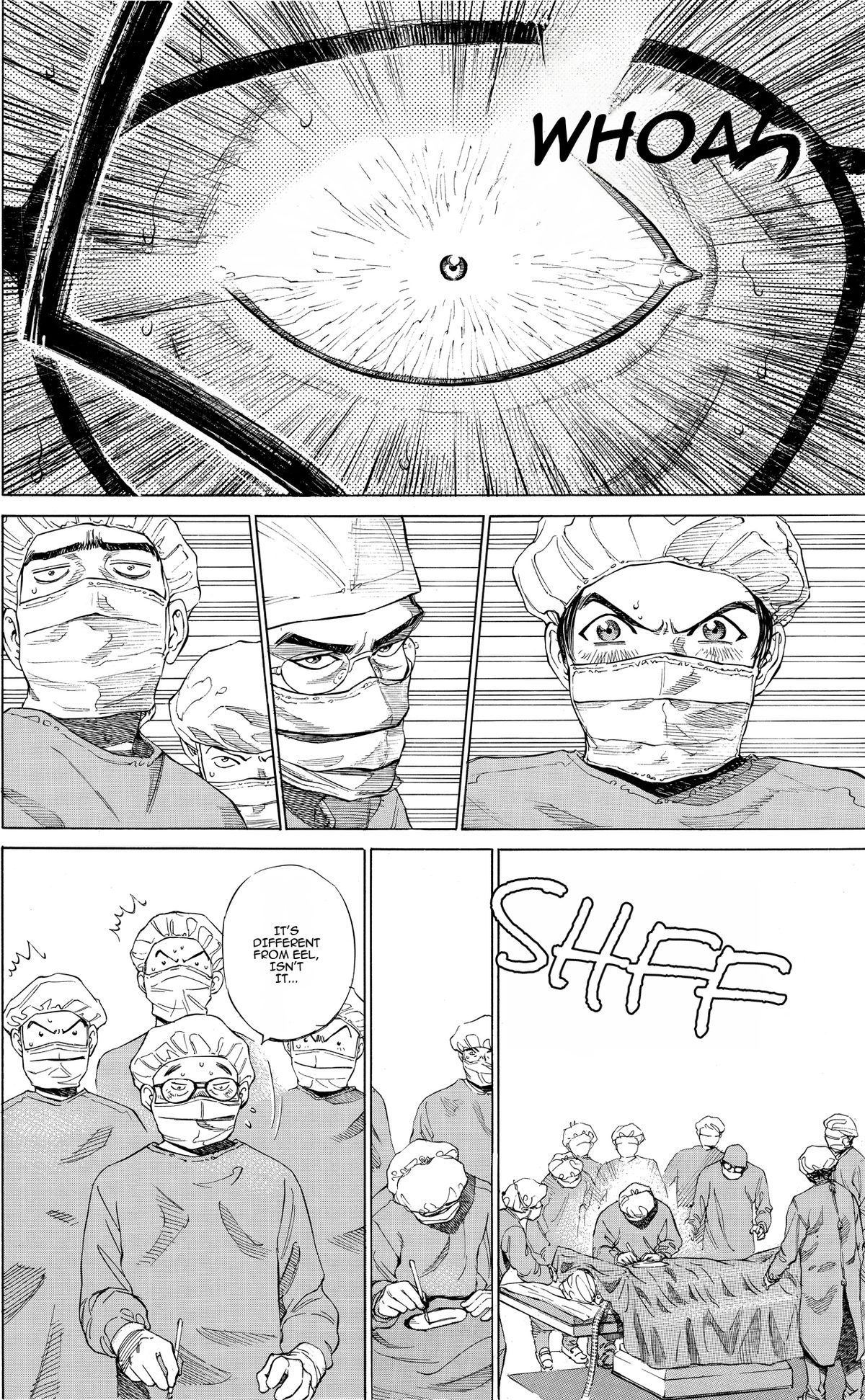
How do you redraw a manga sound effect without damaging the art?

A sound effect sits on top of screentone, speed lines and faces. The hard part is not the new word. It is taking the old one out and leaving everything else.
Erase only the pixels that belong to the letters, not a box around them. Refill flat ground with its own colour and repaint only textured art. Then letter the new word at the source letter height, angle and stroke weight, and add an outline only when the word would be hard to read without one.
Bublate redraws a sound effect in four moves: find the letters, erase them, letter the new word, and decide on an outline. This post explains the rules behind each move. Each rule exists because an earlier version broke a real page in review. If you want the short version of what the feature does, see sound effect translation.
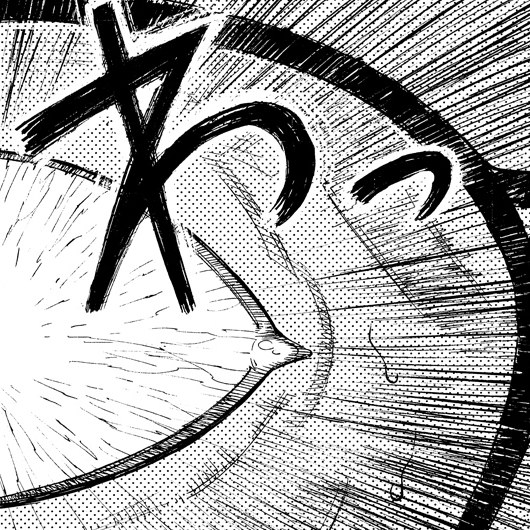
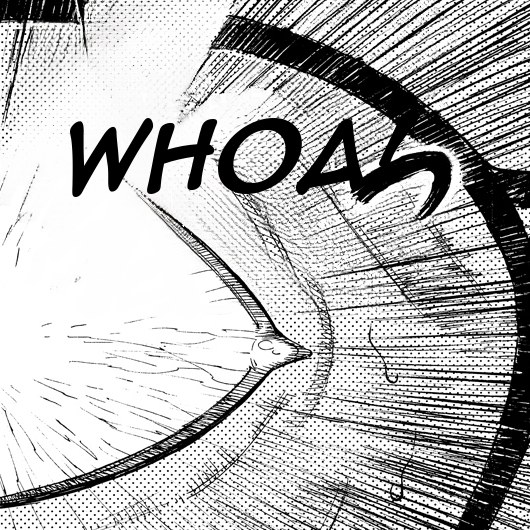
Why is erasing a sound effect harder than erasing a speech bubble?
A speech bubble has a flat white inside. Fill the text area with white and the job is done. A sound effect is drawn on the art itself. Under the strokes there is screentone, hatching, a hand, sometimes an eye. A box-shaped erase takes all of that with it.
So Bublate never erases a box. A text detector (comic-text-detector) makes a per-pixel text map for each segment, and the erase mask comes from that map, grown by one stroke width. Where the ring around the masked area is one flat colour, the area gets that colour. Only textured art goes to the inpainting model, a manga-tuned version of LaMa that repaints the gap from what surrounds it. Read more about the bubble side in manga cleaning.
What are the three kinds of sound effect?
Every sound effect gets one of three erase routes. The route decides what may change and what must stay.
| Kind | What it looks like | What Bublate erases | What it keeps |
|---|---|---|---|
| Plate (balloon) sound effect | Letters inside a closed white burst or plate | Only the letters inside, filled with the plate colour, plus stroke tips that cross the rim | The rim and everything outside it |
| Sound effect on art | Letters drawn straight on tone, lines or figures | Only pixels near the letter colours, inside the text map | Art under the letters (tone, hatching, faces) |
| Large heavy sound effect | Big brush letters that cover a panel | The text map plus a letter-colour mask when the map covers under 70% of the letter pixels | Art between the strokes |
Plate sound effects keep their plate
Many artists draw a sound effect inside its own white burst. An early version erased everything in the box, and the burst lost its outline, because brush tips touch the rim and the rim was erased with them. Now Bublate finds the closed white balloon around the word, keeps it, and changes only the letter pixels inside. Each new word is centred on its source word and fitted inside the balloon shape. The same word in one segment gets one size.
A later review found the opposite fault: a stroke tip that crossed the rim stayed behind as a small mark. Text pixels just outside the balloon now go to the inpainting step. The rim is not text to the detector, so it stays.
Sound effects on art: colour decides
For letters drawn straight on the art, the erase takes only pixels close to the letter colours. The match area grows with the letter size, so the soft edge of a big stroke goes too. When the detector names one colour and the pixels say another (light letters on a dark ground, for example), the pixels win.
When does Bublate add an outline?
Only when the new word would be close to invisible without one. When the source word has no outline, Bublate measures the contrast ratio between the fill colour and the cleaned ground under the word, with the same formula the W3C uses in its accessibility guidelines. Under 1.5:1, it adds a black or white outline. At 1.5:1 or more, it draws the fill alone, the way the artist drew it.
The line used to be 3:1, the level WCAG 2.2 asks of large text on screens. That added outlines the artists never drew. A comic page is art, not an interface, so the rule now follows the source pen and steps in only when the word would disappear.
Outlines have a floor too. A measured edge of about 1% of the letter height drew under one pixel on a BANG, so its white edge vanished. The outline is now at least 2 px, or 1/30 of the letter size when that is larger.
When the source has its own outline, Bublate copies it. The thickest ink is the fill, and a thinner ink that hugs it is the outline, with its measured width. Hollow letters (thin lines around ground-coloured letters) stay hollow.
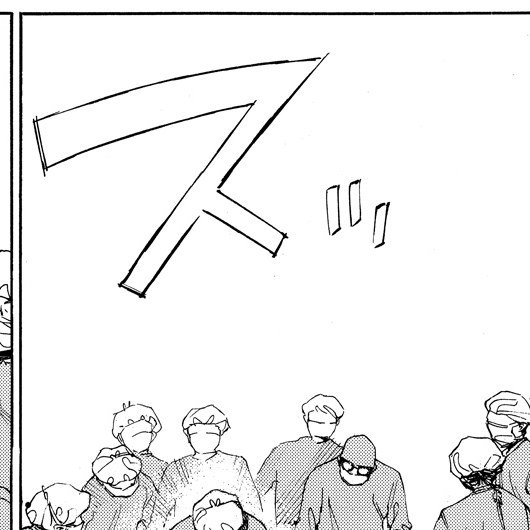
How does Bublate match size and stroke weight?
Size comes from the ink, not from the box. A translation is rarely as long as the source, and stretching it into the source box changes its letter height, which is what the eye reads as size. Bublate levels the source ink by its angle, takes the median letter height, renders the new word in its font, measures it the same way and scales until the two heights match.
- Height. One Hangul syllable is one letter. For a stacked word, height is the whole stack divided by the syllable count.
- Footprint. A one-line word may grow toward the source length within 0.85x to 1.6x of the matched height. A hard limit stops it at 1.4x the source length and 90% of the panel. Hangul syllables are dense squares, so Latin capitals at the same height cover less ground.
- Angle. From the text reader when it read the word, else from the long axis of the ink.
- Weight. The source stroke width divided by its letter height gives a weight class. Each font role maps that class to the closest-weight font, so a heavy brush stroke gets a heavy face and a thin pen line gets a light one. Weight is measured on pixels closer to the fill than to the ground or the outline, the same 50% rule a rendered font gets.
What are font roles?
A font role is a job, not a typeface: brush sound effects, cute sound effects, impact words, narration, system windows. The letter stage picks a role for each sound effect from the scene and the genre, then picks the family inside that role. One chapter uses one font per role, decided by majority, so the same kind of sound looks the same on every page. Words inside a balloon always use the chapter's impact font, because brush lettering in a balloon is heavy and a thin hand font looked weak there.
We tried a shared library of standard English sound effects and dropped it. The same sound reads differently in a romance, a comedy and an action story, and a library pulled every series toward the same words. The translator now picks each word for the scene. The Korean and Japanese dictionaries stay as reading aids only.
What still goes wrong?
Version 1 of the pipeline was frozen on 2026-10-10. On a 34-segment Korean chapter it passed 17 of 18 cases in our regression set, a list of every fault found in review. These faults remain, and the page editor is built to fix them by hand:
- A sound effect can come out much larger than the source and cover a face or cross a panel edge.
- Small source marks can stay behind: emphasis dots, thin traces under a line.
- A sound effect the detector misses stays untranslated.
- Art inside a sound effect area can lose detail, for example the letters of a sign under a word.
Bublate does the first pass. A letterer still makes the final call, and the editor shows every block with its route and any flag from the visual check. To read how the words get read in the first place, see our test of 9 models on brush-drawn Korean sound effects.
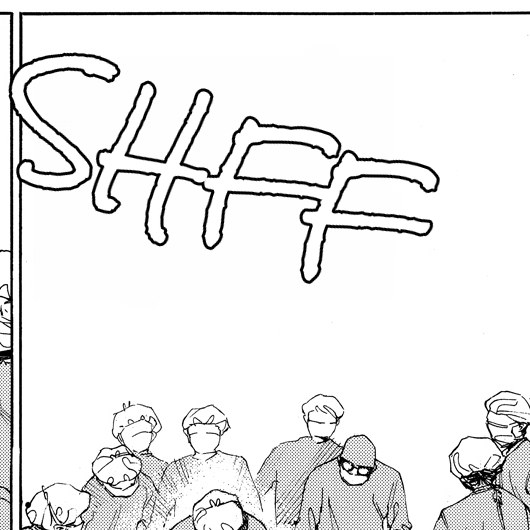
Method: rules and numbers come from the Bublate pipeline code and its review log, 2026-10-08 to 2026-10-10. Figures are untouched output from the cloud pipeline. Art: "Give My Regards to Black Jack" by SHUHO SATO.
Frequently asked questions
Does Bublate erase the screentone under a sound effect?
No. On art, it erases only pixels close to the letter colours inside a per-pixel text map. Tone and line work under the letters stay. Flat areas are refilled with their own colour, and only textured gaps go to the inpainting model to be repainted.
Why do some redrawn sound effects have an outline and others not?
Bublate adds an outline only when the fill has less than 1.5:1 contrast with the cleaned ground, so the word does not vanish. If the source word had its own outline, Bublate copies its colour and width. Hollow source letters stay hollow.
How does Bublate choose the size of the new word?
It matches letter height, measured from the source ink, not from the box. A one-line word may then grow toward the source length, up to 1.4x that length and 90% of the panel. The stroke weight sets which font weight it uses.
What happens to sound effects inside a white burst?
The burst stays. Only the letters inside it are erased and refilled with the burst colour, and the new word is fitted inside the burst shape. Stroke tips that cross the rim are cleaned too, but the rim itself is never erased.
Can I fix a sound effect by hand?
Yes. The page editor shows each block with its box, colours, angle and font, so you can move, resize or reword it before export. You can also keep the drawn sound effect and add a small caption instead, or restore the source art with the restore brush.
Sources
- W3C, Understanding Success Criterion 1.4.3: Contrast (Minimum), WCAG 2.2 · checked
- dmMaze, comic-text-detector (GitHub) · checked
- Suvorov et al., LaMa: Resolution-robust Large Mask Inpainting with Fourier Convolutions (WACV 2022) · checked
- ogkalu, lama-manga-onnx-dynamic (Hugging Face, Apache-2.0) · checked
Related
Written by the Bublate team. We build tools that translate and letter comics, and we publish what we measure along the way.
Stories about comics in every language, once a month
Related articles
Translate a comic chapter from Claude or ChatGPT (MCP)
By the Bublate teamBublate runs a remote MCP server at bublate.com/mcp. Connect Claude, ChatGPT or Cursor, and ask it to translate and re-letter a webtoon or manga chapter.Comic translation API: chapters from your own pipeline
By the Bublate teamThe Bublate API takes webtoon and manga pages, translates and re-letters them, and calls your server when a chapter is ready. Five requests, with curl examples.