Russian to Chinese (Traditional)
Translate Russian comics into Traditional Chinese
Bublate translates Russian comics into Traditional Chinese and letters every page. Бах (bakh) becomes 轟 (hōng). Ты and вы map to 你 and 您. Each Traditional Chinese line is re-fitted to balloons drawn for Russian. Traditional Chinese text is 48% narrower than Russian at one font size.
Traditional Chinese text is 48% narrower than Russian at one font size. Бац (bats) becomes 砰 (pēng). Ты and вы map to 你 and 您. A title like товарищ (tovarishch) meets Traditional Chinese titles like 大人 (dàrén). Плюх (plyukh) becomes 撲通 (pūtōng). A kin word like бабушка (babushka) can become 姐姐 (jiějie).
What changes from Russian to Traditional Chinese
Script, 48% less line width, capital letters and forms of address change from Russian to Traditional Chinese.
Cyrillic to Han (Traditional)
Russian is written in the Cyrillic script and Traditional Chinese in the Han (Traditional) script. Traditional Chinese has more characters, with fuller shapes, than Simplified Chinese. Cyrillic letters have capital and small forms, and the spaces between words are the main places to break a line. Traditional Chinese lettering cannot use capital letters, as Russian lettering can. Bublate breaks Traditional Chinese lines at phrase boundaries (BudouX), because Traditional Chinese has no spaces between words.
48% shorter lines
Traditional Chinese text is about 48% narrower than the same Russian text at one font size (FLORES-200). It has 68% fewer characters. Traditional Chinese text leaves room in balloons drawn for Russian, so Bublate can keep a large, readable size.
"You" and titles
Both languages mark respect in the word for "you": Russian ты or вы, Traditional Chinese 你 or 您. Keep the level the Russian characters use for each other. Russian titles such as товарищ (tovarishch) and уважаемый (uvazhayemyy) meet Traditional Chinese titles such as 大人 (dàrén) and 先生 (xiānshēng). Kin words for friends: Russian бабушка (babushka) and девушка (devushka), Traditional Chinese 姐姐 (jiějie) and 叔叔 (shūshu).
Russian comics for Traditional Chinese readers
Japanese titles were 91.55% of the comics that Taiwan publishers released in 2017. Taiwanese titles were 6.14%. Platforms in Traditional Chinese include BOOK☆WALKER Taiwan, Culturecom and Jade Dynasty.
In 2023, graphic novels, comics and manga made almost 10% of the Russian book market. In 2022, the share was 6.5%. In 2024, Russian sales of Asian comics fell 16.2% to 3.3 billion rubles. Russian comics come from МИФ (Mann, Ivanov and Ferber) and Азбука (Azbuka).
Traditional Chinese readers search for "漫畫 中文 狀 聲 詞", "webtoon premium" and "webtoon漫畫" (Google autocomplete, 2026-11-22).
Side by side
| Russian | Chinese (Traditional) | |
|---|---|---|
| Script | Cyrillic | Han (Traditional) |
| Capital letters | Yes | No |
| Spaces between words | Yes | No |
| Line width against English (same size) | 122% | 63% |
| Quotation marks | « » | 「 」 |
| 12,500.5 written as | 12 500,5 | 12,500.5 |
| Line breaks in Bublate | At spaces | Between phrases |
| Characters against English | 111% | 36% |
| Digits | 0 to 9 | 0 to 9, 〇一二三 |
| Titles | товарищ (tovarishch), уважаемый (uvazhayemyy), Александр Андреевич (Aleksandr Andreyevich) | 大人 (dàrén), 先生 (xiānshēng), 老師 (lǎoshī) |
| Kin words used for friends | бабушка (babushka), девушка (devushka), дядя (dyadya) | 姐姐 (jiějie), 叔叔 (shūshu), 阿姨 (āyí) |
| Words for comics | комикс (komiks) | 狀聲詞 (zhuàngshēngcí) |
| Words for comics | манга (manga) | 漫畫 (mànhuà) |
| Familiar and polite "you" | ты, вы | 你, 您 |
| Explosion | бах (bakh), бабах (babakh) | 轟 (hōng) |
| Heavy impact | бац (bats), трах (trakh) | 砰 (pēng) |
| Crash | хрясь (khryas') | 嘩啦 (huālā) |
| Knock | тук-тук (tuk-tuk) | 咚 (dōng) |
| Splash | плюх (plyukh) | 撲通 (pūtōng) |
| Fast swoosh | вжух (vzhukh) | 嗖 (sōu) |
| Ticking clock | тик-так (tik-tak) | 滴答 (dīdā) |
| Laughter | ха-ха (kha-kha) | 哈哈 (hāhā) |
| Kiss | чмок (chmok) | 啾 (jiū) |
| Dog | гав (gav) | 汪汪 (wāngwāng) |
| Cat | мяу (myau) | 喵 (miāo) |
| Rooster | кукареку (kukareku) | 喔喔 (wōwō) |
| Sneeze | апчхи (apchkhi) | 哈啾 (hājiū) |
Russian sound effects in Traditional Chinese
13 sounds with a word on both sides.
бах to 轟
Бах (bakh) becomes 轟 (hōng) (an explosion), бац (bats) becomes 砰 (pēng) (a heavy impact), хрясь (khryas') becomes 嘩啦 (huālā) (a crash) and тук-тук (tuk-tuk) becomes 咚 (dōng) (a knock). Russian has no rule to make a sound word from a verb stem, as Norwegian does. A translator picks a Russian sound word for each case. A 1997 Taiwan edition of a Taiyo Matsumoto book kept the drawn kana with a small gloss. The 2017 edition redrew each one by hand in Chinese.
Traditional Chinese punctuation
Quotation marks change from « » in Russian to 「 」 in Traditional Chinese. Russian 12 500,5 becomes 12,500.5 in Traditional Chinese. In Taiwan and Hong Kong, the middle dot (·) takes a full character width. In mainland China it takes half. On the Russian side: With an ellipsis, the Russian ? or ! takes the place of the first dot: ?.. and !..
Page order and text direction
Russian comics read from left to right. Russian manga editions keep the Japanese order, from right to left. Most print comics in Taiwan are Japanese manga in translation. Their Traditional Chinese editions keep the right to left page order. Taiwan and Hong Kong have no rule for text direction. Leisure books for young readers, such as comics, mostly use vertical text. Bublate sets Traditional Chinese in horizontal lines.

Lettering Traditional Chinese
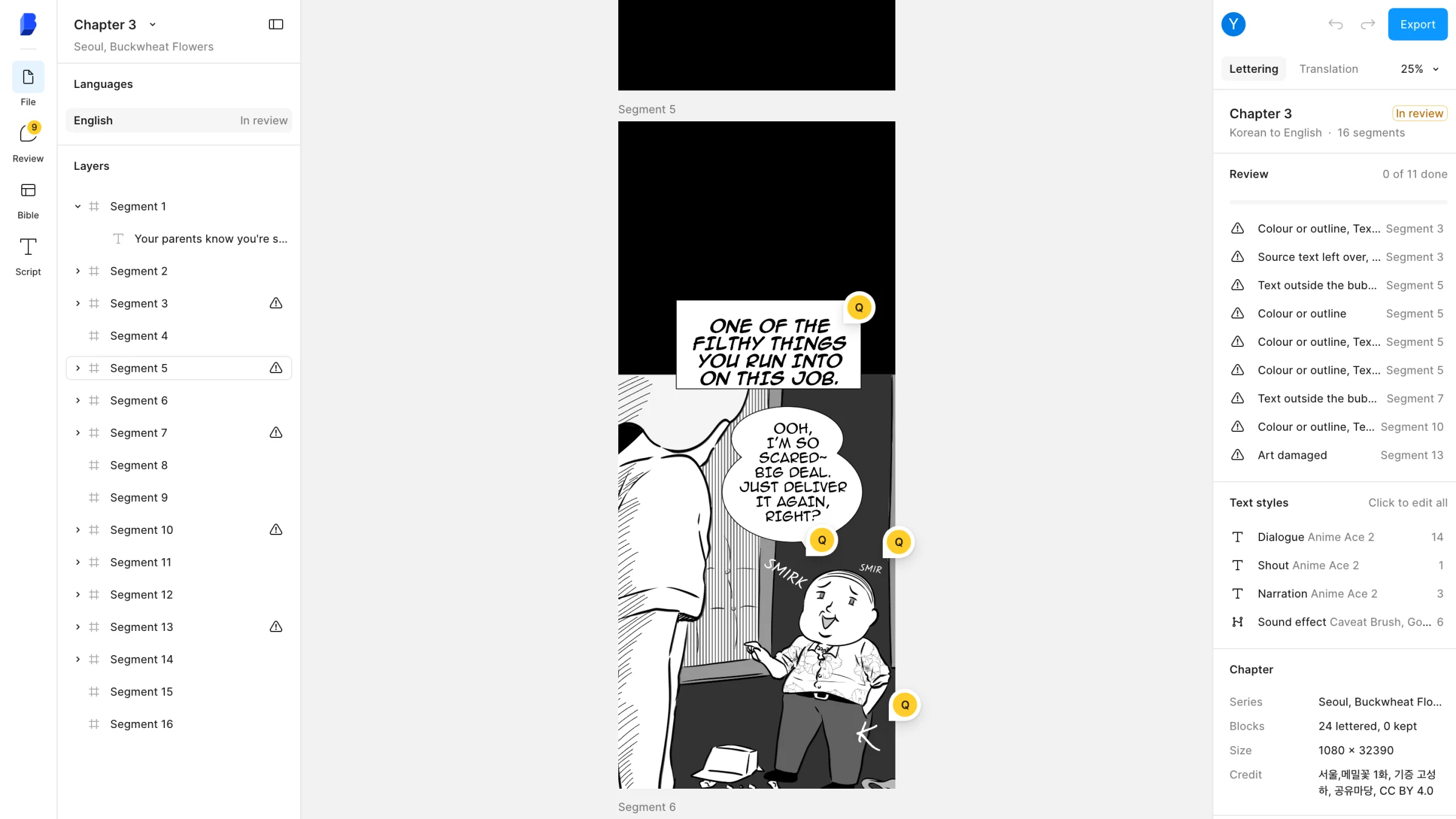
A lettering guide for Lezhin's Taiwan webtoon editions sets all balloon text horizontally and centered, with 130% line spacing. The guide names comic fonts for Russian text, such as Anime Ace, Digital Strip and Kid Kosmic. Russian balloon text keeps one size on all pages. Smaller type shows a whisper or doubt. Larger type shows a shout or stress.
Bublate letters Traditional Chinese with fonts made for the Han (Traditional) script. See the how to translate your webcomic, bubble font size calculator and how to letter comics.
Sources
- r12a, Chinese orthography notes · checked
- r12a, Russian (Cyrillic) orthography notes · checked
- FLORES-200 devtest, 1,012 sentences in 200 languages (NLLB Team, CC BY-SA 4.0), measured by Bublate · checked
- Мангалекторий: Текст в комиксе, манге и BD (часть 2) · checked
- Читай-город: Как читать мангу · checked
- 維基百科: 縱書與橫書 (漫畫 and 臺灣、香港 sections) · checked
- 行政院 (文化部 briefing, 2019): 漫畫作品國別分布 2017 (PDF) · checked
- Грамота.ру, Письмовник: Товарищ или господин? Как правильно обратиться · checked
- Викисловарь: товарищ · checked
- Грамота.ру, журнал: Отчество в русском речевом этикете · checked
- Wiktionary: 大人 (Chinese) · checked
- 教育部國語辭典簡編本: 先生 · checked
- 教育部國語辭典簡編本: 老師 · checked
- Викисловарь: бабушка · checked
- Викисловарь: девушка · checked
- Викисловарь: дядя · checked
- Wiktionary: 姐姐 (Chinese) · checked
- Wiktionary: 叔叔 (Chinese) · checked
- Wiktionary: 阿姨 (Chinese) · checked
- Викисловарь: бах · checked
- CC-CEDICT (MDBG): 轟 · checked
- Викисловарь: бац · checked
- CC-CEDICT (MDBG): 砰 · checked
- Викисловарь: хрясь · checked
- CC-CEDICT (MDBG): 嘩啦 · checked
- Wiktionary: тук-тук · checked
- CyberLeninka: Е. В. Воробьева, Проблема передачи ономатопей на примере перевода комиксов с норвежского языка на русский · checked
- CC-CEDICT (MDBG): 咚 · checked
- Викисловарь: плюх · checked
- CC-CEDICT (MDBG): 撲通 · checked
- Викисловарь: вжух · checked
- CC-CEDICT (MDBG): 嗖 · checked
- Викисловарь: тик-так · checked
- CC-CEDICT (MDBG): 滴答 · checked
- Викисловарь: ха-ха · checked
- CC-CEDICT (MDBG): 哈哈 · checked
- Викисловарь: чмок · checked
- CC-CEDICT (MDBG): 啾 · checked
- Викисловарь: гав · checked
- CC-CEDICT (MDBG): 汪汪 · checked
- Викисловарь: мяу · checked
- CC-CEDICT (MDBG): 喵 · checked
- Викисловарь: кукареку · checked
- CC-CEDICT (MDBG): 喔 · checked
- Викисловарь: апчхи · checked
- CC-CEDICT (MDBG): 哈啾 · checked
- OKAPI (博客來): 松本大洋漫畫裡的中文狀聲詞怎麼寫出來的? (2018-01-15) · checked
- Unicode CLDR 49.0.0: delimiters and number symbols · checked
- W3C: Requirements for Chinese Text Layout (clreq) · checked
- Грамота.ру, Правила русской орфографии и пунктуации (под ред. В. В. Лопатина), § 154: Сочетание знаков препинания · checked
- TOTUS guide: 웹툰 식자 가이드, 레진코믹스 (TW) · checked
- Культура: Доля комиксов на российском книжном рынке составила почти 10% · checked
- Ведомости: В 2024 году мужчины стали покупать больше книг (2025-02-14) · checked
- BOOK☆WALKER 台灣漫讀 · checked
- 文化傳信: company history · checked
- 玉皇朝國際: 日本漫畫資訊 正式授權 · checked
- Коммерсантъ: Манхьовая пелена, как развивается рынок азиатских комиксов в России (2023) · checked
- Манн, Иванов и Фербер · checked
- Издательство Азбука · checked
- Викисловарь: комикс · checked
- CC-CEDICT (MDBG): 狀聲詞 · checked
- Викисловарь: манга · checked
- CC-CEDICT (MDBG): 漫畫 · checked
- Wiktionary: 漫畫 (Chinese) · checked
- Викисловарь: бабах · checked
- Викисловарь: трах · checked
Related
Learn more
Russian to Spanish
Translate Russian comics into Spanish: script, length, forms of address and sound effects compared.
Learn moreRussian to Portuguese (Brazil)
Translate Russian comics into Brazilian Portuguese: script, length, forms of address and sound effects compared.
Learn moreSwahili to Chinese (Traditional)
Translate Swahili comics into Traditional Chinese: script, length, forms of address and sound effects compared.
Learn moreQuestions
How do I translate Russian comics into Traditional Chinese?
Upload the Russian pages and pick Chinese (Traditional). Bublate letters each balloon in Han (Traditional) script, and хрясь (khryas') becomes 嘩啦 (huālā), тук-тук (tuk-tuk) becomes 咚 (dōng). A webtoon chapter costs $3, a manga page up to $0.60, with 30 free credits.
How are Russian forms of address handled in Traditional Chinese?
Both languages mark respect in the word for "you": Russian ты or вы, Traditional Chinese 你 or 您. Keep the level the Russian characters use for each other. Russian titles such as товарищ (tovarishch) and уважаемый (uvazhayemyy) meet Traditional Chinese titles such as 大人 (dàrén) and 先生 (xiānshēng).
What happens to Russian sound effects in Traditional Chinese?
Each one gets a Traditional Chinese word for the same sound: тук-тук (tuk-tuk) becomes 咚 (dōng) (a knock), плюх (plyukh) becomes 撲通 (pūtōng) (a splash), вжух (vzhukh) becomes 嗖 (sōu) (a fast swoosh), тик-так (tik-tak) becomes 滴答 (dīdā) (a ticking clock) and ха-ха (kha-kha) becomes 哈哈 (hāhā) (laughter). A 1997 Taiwan edition of a Taiyo Matsumoto book kept the drawn kana with a small gloss. The 2017 edition redrew each one by hand in Chinese.
Does Traditional Chinese text fit balloons drawn for Russian?
Traditional Chinese text is about 48% narrower than the same Russian text at one font size (FLORES-200). It has 68% fewer characters. Traditional Chinese text leaves room in balloons drawn for Russian, so Bublate can keep a large, readable size.