Korean to Hebrew
Translate Korean manhwa into Hebrew
Bublate translates Korean manhwa into Hebrew and letters every page. 쾅 (kwang) becomes זבנג (zbang). Each Hebrew line is set right to left and re-fitted to balloons drawn for Korean. Hebrew text is 7% narrower than Korean at one font size.
Hebrew runs right to left, Korean left to right. Hebrew text is 7% narrower than Korean at one font size. 펑 (peong) becomes בום (bum). A title like 씨 (ssi) meets Hebrew titles like מר (mar). 똑똑 (ttok-ttok) becomes תוק־תוק (tuk tuk). A kin word like 언니 (eonni) can become אחי (akhi).
What changes from Korean to Hebrew
Line direction, script, 7% less line width and forms of address change from Korean to Hebrew.
Hangul to Hebrew
Hebrew runs right to left, Korean left to right. Korean is written in the Hangul script and Hebrew in the Hebrew script. Hebrew has vowel points (niqqud) but rarely writes them in normal text. Korean can be set horizontally or vertically.
7% shorter lines
Hebrew text is about 7% narrower than the same Korean text at one font size (FLORES-200). It has 66% more characters. Most Hebrew lines fit the Korean balloons at a similar size. Bublate re-fits each balloon to the new text.
"You" and titles
Korean 반말 is the plain speech of close friends. It neither raises nor lowers the listener. Hebrew has different forms of "you" for a man and a woman. אתה (atá) is the masculine singular form. Korean titles such as 씨 (ssi) and 군 (gun) meet Hebrew titles such as מר (mar) and גברת (gveret). Kin words for friends: Korean 언니 (eonni) and 누나 (nuna), Hebrew אחי (akhi).
Korean comics for Hebrew readers
Israel publishes comic books and graphic novels only on a small scale, both original and translated. Platforms in Hebrew include Steimatzky, Comikaza and Israeli Museum of Caricature and Comics.
Korean publishers deposited 5,941 new comic titles in 2024. 2,652 were translations, and 2,595 of them came from Japan. The Korean webtoon industry had revenue of 2,285.6 billion won in 2024, 4.4% more than in 2023. Korean comics come from Lezhin Comics and RIDI.
Hebrew readers search for "manhwa online", "manhwa recommendations" and "מנגה תרגום לעברית" (Google autocomplete, 2026-11-22).
Side by side
| Korean | Hebrew | |
|---|---|---|
| Script | Hangul | Hebrew |
| Line direction | Left to right | Right to left |
| Line width against English (same size) | 78% | 73% |
| Quotation marks | “ ” | ” ” |
| Characters against English | 46% | 77% |
| Titles | 씨 (ssi), 군 (gun), 선배 (seonbae) | מר (mar), גברת (gveret) |
| Kin words used for friends | 언니 (eonni), 누나 (nuna), 형 (hyeong) | אחי (akhi) |
| Words for comics | 만화책 (manhwachaek) | מנהווה (manhwa) |
| Words for comics | 말풍선 (malpungseon) | וובטון (webtoon) |
| Heavy impact | 쾅 (kwang) | זבנג (zbang) |
| Explosion | 펑 (peong) | בום (bum) |
| Crash | 와장창 (wajangchang) | טראח (trakh) |
| Heartbeat | 두근두근 (dugeun-dugeun) | בום־בום (bum bum) |
| Knock | 똑똑 (ttok-ttok) | תוק־תוק (tuk tuk) |
| Laughter | 하하 (haha) | חחח (khakhakha) |
| Gulp | 꿀꺽 (kkulkkeok) | שלוק (shluk) |
| Dog | 멍멍 (meongmeong) | הב־הב (hav hav) |
| Cat | 야옹 (yaong) | מיאו (myau) |
| Rooster | 꼬끼오 (kkokkio) | קוקוריקו (kukuriku) |
| Sneeze | 에취 (echwi) | אפצ׳י (apchi) |
Korean sound effects in Hebrew
11 sounds with a word on both sides.
쾅 to זבנג
쾅 (kwang) becomes זבנג (zbang) (a heavy impact), 펑 (peong) becomes בום (bum) (an explosion), 와장창 (wajangchang) becomes טראח (trakh) (a crash) and 두근두근 (dugeun-dugeun) becomes בום־בום (bum bum) (a heartbeat). Korean sound words come in sets of different strength. 쾅 sounds harder than 꽝. Hebrew writes some repeated sound words with a maqaf (־) between the halves, as in תוק־תוק.
Hebrew punctuation
Quotation marks change from “ ” in Korean to ” ” in Hebrew. The Hebrew question mark (?) faces the same way as in English. It is not mirrored. On the Korean side: The 2015 Korean punctuation rules cover only horizontal writing, because ordinary documents are now rarely vertical.
Page order and text direction
Korean manhwa in print read from left to right, like English books. Korean editions of Japanese manga keep the Japanese right to left order, a rule since the mid-1990s. Hebrew comics read from right to left, like Japanese manga. A Hebrew edition of a left-to-right comic must flip its pages.

Lettering Hebrew
Hebrew has no capital letters. The all-capitals style of English comics has no Hebrew equivalent. Hangul can be set horizontally or vertically. In horizontal text, characters run left to right and lines run top to bottom. The Korea Manhwa Contents Agency and Yoon Design made 만화진흥원체, a free font for comic creators. It is a condensed, rounded gothic font.
Bublate letters Hebrew with fonts made for the Hebrew script. See the Korean sound effect dictionary, honorifics in manhwa, Korean romanization converter, bubble font size calculator and how to letter comics.
Sources
- r12a, Hebrew orthography notes · checked
- r12a, Korean orthography notes · checked
- FLORES-200 devtest, 1,012 sentences in 200 languages (NLLB Team, CC BY-SA 4.0), measured by Bublate · checked
- Wikipedia: Manhwa (reading direction) · checked
- 위키백과: 일본 만화 (Korean editions and binding) · checked
- Drawn & Quarterly: Rutu Modan interviewed by Joe Sacco · checked
- 표준국어대사전: 반말 · checked
- Wiktionary: אתה · checked
- Wiktionary: 씨 (Korean, usage notes) · checked
- 표준국어대사전: 군 (君) · checked
- 표준국어대사전: 선배 (先輩) · checked
- Wiktionary: מר · checked
- Wiktionary: גברת · checked
- Wiktionary: 언니 (Korean) · checked
- Wiktionary: 누나 (Korean) · checked
- Wiktionary: 형 (Korean) · checked
- Wiktionary: אחי · checked
- 표준국어대사전: 쾅 · checked
- Wikipedia: Cross-linguistic onomatopoeias · checked
- 표준국어대사전: 펑 · checked
- Wiktionary: בום · checked
- 표준국어대사전: 와장창 · checked
- 표준국어대사전: 두근두근 · checked
- Wiktionary: 똑똑 (Korean) · checked
- 표준국어대사전: 하하 · checked
- Wiktionary: חחח · checked
- 표준국어대사전: 꿀꺽 · checked
- 표준국어대사전: 멍멍 · checked
- 표준국어대사전: 야옹 · checked
- Wiktionary: מיאו · checked
- 표준국어대사전: 꼬끼오 · checked
- 표준국어대사전: 에취 · checked
- Wiktionary: אפצ׳י · checked
- Microsoft Hebrew Localization Style Guide · checked
- Unicode CLDR 49.0.0: delimiters and number symbols · checked
- 국립국어원: 한글 맞춤법 부록, 문장 부호 (2015) with commentary · checked
- W3C: Hebrew Layout Requirements (hlreq, editor's draft) · checked
- W3C: Requirements for Hangul Text Layout and Typography (klreq) · checked
- 윤디자인: 만화진흥원체 (KOMACON font) · checked
- Hebrew Wikipedia: קומיקס בישראל · checked
- 대한출판문화협회: 2024년 기준 한국 출판생산통계 (PDF) · checked
- 한국콘텐츠진흥원: 2025 웹툰산업 실태조사 (press release, 2025-12-29) · checked
- Steimatzky: Radiant 1 (Hebrew manga, Modan) · checked
- Steimatzky: Twisted Wonderland, the manga 1 (Hebrew, Yedioth Books) · checked
- Comikaza (comic book store, Tel Aviv) · checked
- Wikipedia: Comikaza · checked
- Israeli Museum of Caricature and Comics, Holon · checked
- 레진코믹스 · checked
- 리디 웹툰 · checked
- 표준국어대사전: 만화책 · checked
- Hebrew Wikipedia: מנהווה · checked
- 표준국어대사전: 말풍선 · checked
Related
Learn more
Korean to Hindi
Translate Korean manhwa into Hindi: script, length, forms of address and sound effects compared.
Learn moreKorean to Hungarian
Translate Korean manhwa into Hungarian: script, length, forms of address and sound effects compared.
Learn more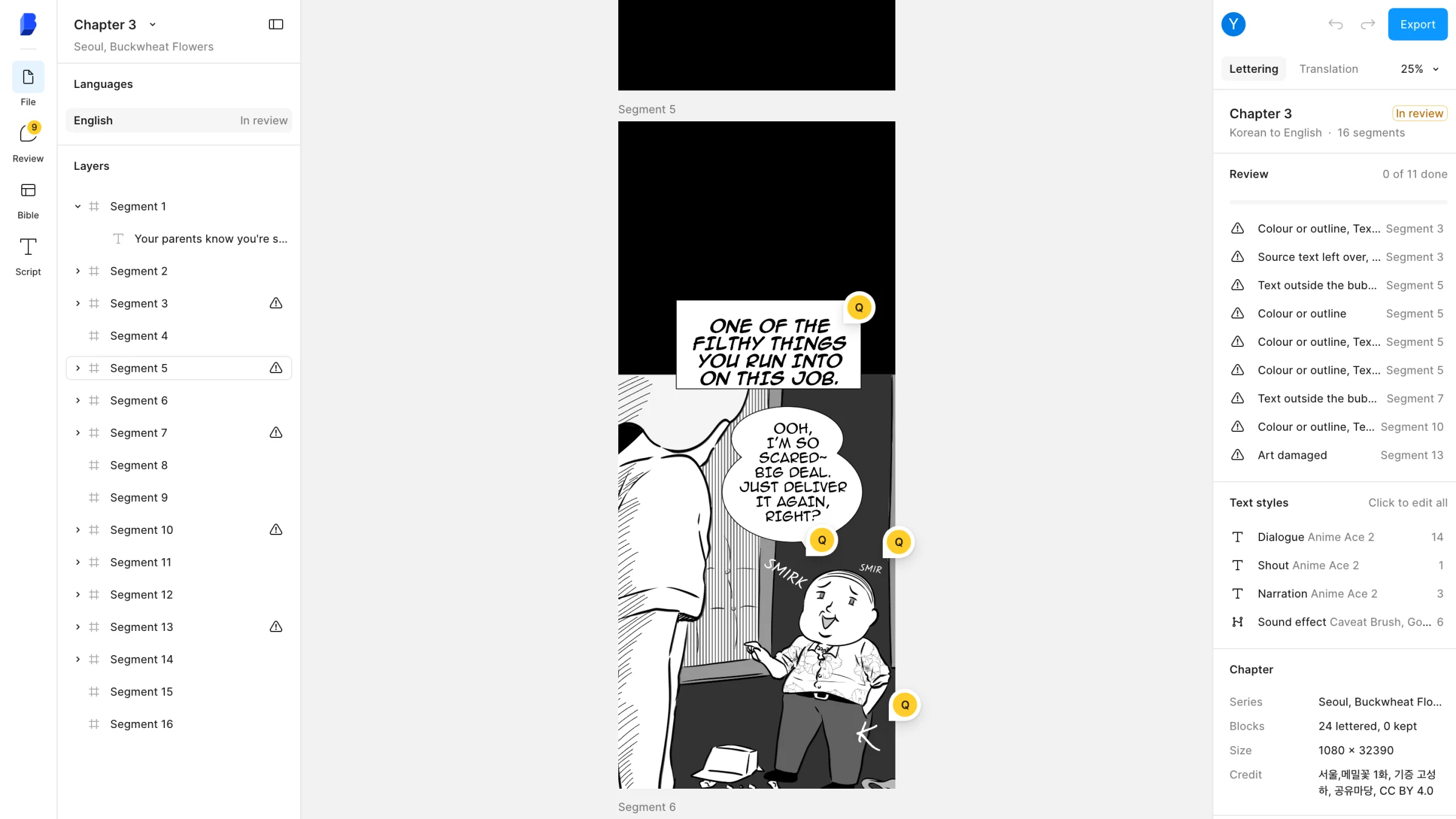
Japanese to Hebrew
Translate Japanese manga into Hebrew: script, length, forms of address and sound effects compared.
Learn moreQuestions
How do I translate Korean manhwa into Hebrew?
Upload the Korean pages and pick Hebrew. Bublate letters each balloon right to left in Hebrew script, and 와장창 (wajangchang) becomes טראח (trakh), 두근두근 (dugeun-dugeun) becomes בום־בום (bum bum). A webtoon chapter costs $3, a manga page up to $0.60, with 30 free credits.
How are Korean forms of address handled in Hebrew?
Korean 반말 is the plain speech of close friends. It neither raises nor lowers the listener. Hebrew has different forms of "you" for a man and a woman. אתה (atá) is the masculine singular form. Korean titles such as 씨 (ssi) and 군 (gun) meet Hebrew titles such as מר (mar) and גברת (gveret).
What happens to Korean sound effects in Hebrew?
Each one gets a Hebrew word for the same sound: 두근두근 (dugeun-dugeun) becomes בום־בום (bum bum) (a heartbeat), 똑똑 (ttok-ttok) becomes תוק־תוק (tuk tuk) (a knock), 하하 (haha) becomes חחח (khakhakha) (laughter), 꿀꺽 (kkulkkeok) becomes שלוק (shluk) (a gulp) and 멍멍 (meongmeong) becomes הב־הב (hav hav) (a dog). Hebrew writes some repeated sound words with a maqaf (־) between the halves, as in תוק־תוק.
Does Hebrew text fit balloons drawn for Korean?
Hebrew text is about 7% narrower than the same Korean text at one font size (FLORES-200). It has 66% more characters. Most Hebrew lines fit the Korean balloons at a similar size. Bublate re-fits each balloon to the new text.